AddThis

4/26/06

Tom Wolfe: Sorry, But Your Soul Just Died


Tom Wolfe in His
Characteristic
White Suit
Thomas Kennerly Wolfe Jr. (1930 – 2018), was a New Journalistic, and prolific author who wrote, to name a few, The Electric Kool-Aid Acid Test,  The Right Stuff, The Bonfire of the Vanities,  A Man in Full, I Am Charlotte Simmons,  and Back to Blood. Here is what he had to say about modern brain science and how human beings may soon perceive themselves as without free will, a self, or a soul.

“Brain imaging was invented for medical diagnosis. But its far greater importance is that it may very well confirm, in ways too precise to be disputed, certain theories about ‘the mind,’ ‘the self,’ ‘the soul,’ and ‘free will’ that are already devoutly believed in by scholars in what is now the hottest field in the academic world, neuroscience. . . .

“Already there is a new Darwin, or perhaps I should say an updated Darwin, since no one ever believed more religiously in Darwin I than he does. His name is Edward O. Wilson. . . . Every human brain, he says, is born not as a blank tablet (a tabula rasa) waiting to be filled in by experience but as ‘an exposed negative waiting to be slipped into developer fluid.’ . . .

“Feminist protesters invaded a conference where Wilson was appearing, dumped a pitcher of ice water, cubes and all, over his head, and began chanting, ‘You're all wet! You're all wet!’ The most prominent feminist in America, Gloria Steinem, went on television and, in an interview with John Stossel of ABC, insisted that studies of genetic differences between male and female nervous systems should cease forthwith.

“But the new generation of neuroscientists are not cautious for a second. . . . they express an uncompromising determinism.

“They start with the most famous statement in all of modern philosophy, Descartes's ‘Cogito ergo sum,’ ‘I think, therefore I am,’ which they regard as the essence of ‘dualism,’ the old-fashioned notion that the mind is something distinct from its mechanism, the brain and the body. (I will get to the second most famous statement in a moment.) This is also known as the ‘ghost in the machine’ fallacy, the quaint belief that there is a ghostly ‘self’ somewhere inside the brain that interprets and directs its operations. Neuroscientists involved in three-dimensional electroencephalography will tell you that there is not even any one place in the brain where consciousness or self-consciousness ( Cogito ergo sum ) is located. This is merely an illusion created by a medley of neurological systems acting in concert. The young generation takes this yet one step further. Since consciousness and thought are entirely physical products of your brain and nervous system--and since your brain arrived fully imprinted at birth--what makes you think you have free will? Where is it going to come from? What ‘ghost,’ what ‘mind,’ what ‘self,’ what ‘soul,’ what anything that will not be immediately grabbed by those scornful quotation marks, is going to bubble up your brain stem to give it to you? I have heard neuroscientists theorize that, given computers of sufficient power and sophistication, it would be possible to predict the course of any human being's life moment by moment, including the fact that the poor devil was about to shake his head over the very idea. . . .

“Since the late 1970s, in the Age of Wilson, college students have been heading into neuroscience in job lots. The Society for Neuroscience was founded in 1970 with 1,100 members. Today, one generation later, its membership exceeds 26,000. . . .

“Why wrestle with Kant's God, Freedom, and Immortality when it is only a matter of time before neuroscience, probably through brain imaging, reveals the actual physical mechanism that sends these mental constructs, these illusions, synapsing up into the Broca's and Wernicke's areas of the brain?

“Which brings us to the second most famous statement in all of modern philosophy: Nietzsche's ‘God is dead.’ The year was 1882. . . . ‘The story I have to tell,’ wrote Nietzsche, ‘is the history of the next two centuries.’ He predicted (in Ecce Homo ) that the twentieth century would be a century of ‘wars such as have never happened on earth,’ wars catastrophic beyond all imagining. . . .

“A hundred years ago those who worried about the death of God could console one another with the fact that they still had their own bright selves and their own inviolable souls for moral ballast and the marvels of modern science to chart the way. But what if, as seems likely, the greatest marvel of modern science turns out to be brain imaging? . . .

“This sudden switch from a belief in Nurture, in the form of social conditioning, to Nature, in the form of genetics and brain physiology, is the great intellectual event, to borrow Nietzsche's term, of the late twentieth century. . . . .

“Meantime, the notion of a self--a self who exercises self-discipline, postpones gratification, curbs the sexual appetite, stops short of aggression and criminal behavior--a self who can become more intelligent and lift itself to the very peaks of life by its own bootstraps through study, practice, perseverance, and refusal to give up in the face of great odds--this old-fashioned notion (what's a boot strap, for God's sake?) of success through enterprise and true grit is already slipping away, slipping away...slipping away...

.” . . . Where does that leave self-control? Where, indeed, if people believe this ghostly self does not even exist, and brain imaging proves it, once and for all? Orthodoxy Today

4/16/06

A Physicist's Proof of God's Existence: Point and Counterpoint


Point. Physicist Amit Goswami "is convinced, along with a number of others who subscribe to the same view, that the universe, in order to exist, requires a conscious sentient being to be aware of it. Without an observer, he claims, it only exists as a possibility. And as they say in the world of science, Goswami has done his math. Marshalling evidence from recent research in cognitive psychology, biology, parapsychology and quantum physics, and leaning heavily on the ancient mystical traditions of the world, Goswami is building a case for a new paradigm that he calls 'monistic idealism,' the view that consciousness, not matter, is the foundation of everything that is."A professor of physics at the University of Oregon and a member of its Institute of Theoretical Science, Dr. Goswami is part of a growing body of renegade scientists who in recent years have ventured into the domain of the spiritual in an attempt both to interpret the seemingly inexplicable findings of their experiments and to validate their intuitions about the existence of a spiritual dimension of life. The culmination of Goswami's own work is his book The Self-Aware Universe: How Consciousness Creates the Material World. Rooted in an interpretation of the experimental data of quantum physics (the physics of elementary particles), the book weaves together a myriad of findings and theories in fields from artificial intelligence to astronomy to Hindu mysticism in an attempt to show that the discoveries of modern science are in perfect accord with the deepest mystical truths. (Link gone. Formerly at homepages.ihug.co.nz) Another link can be found here.

Counterpoint. "My main objection to Goswami's philosophy is that he has defined consciousness in such a way that it no longer has its normal meaning of mental consciousness, but instead is supposed to refer to something non-mental. We might call this 'Goswamian consciousness' or 'quantum consciousness', as opposed to 'mental consciousness'. He says, for instance:


  • ...consciousness transcends both matter and mind ... [Hard Questions, Sect. II]
  • Conventionally, Western philosophers attribute properties of consciousness - experience and choice - to the mind. This has been corrected in quantum functionalism in which consciousness is defined to transcend both matter and mind. [Hard Questions, Sect. VI]

    In so far as Goswami's philosophy is a monism at all, it is therefore a neutral monism, not a mental monism (or 'monistic idealism' as he calls it). As I have argued elsewhere, any neutral monism is actually identical to a version of physical monism, just because the physical world is already as neutral as a world can be. . . . You will not, for instance, spot any electrons by looking out of the window of the Clapham omnibus*: we are acquainted with the basic constituents of the physical world only through the propositions and formulae of physics. So, those extrinsic properties are the only properties possessed by those entities. Hence, physicalism itself is 'neutral' in the relevant sense. Therefore, to say that a metaphysical theory such as Goswami's is a 'neutral' monism is just to say that it is a 'physical' monism." (Link gone. Formerly at easyweb.easynet.co.uk

  • *(The man on the Clapham omnibus is a hypothetical ordinary and reasonable person, used by the courts in English law where it is necessary to decide whether a party has acted as a reasonable person would – for example, in a civil action for negligence. He is a reasonably educated, intelligent but nondescript person, against whom the defendant's conduct can be measured.)

    My comments. In the counterpoint, an experiential approach is used. (Looking out the window of the Clapham omnibus.) For whatever it is worth, a different kind of experience consistently supports monistic idealism. All the accounts of mystics, be they Christian, Hindu, Buddhists, Sufi, share a pattern of description in terms of monistic idealism. People who report their experiences under hallucinogens also reveal a pattern of monistic idealism.

    For a different perspective, I offer William James' classic, The Varieties of Religious Experience:

    "Medical materialism finishes up Saint Paul by calling his vision on the road to Damascus a discharging lesion of the occipital cortex, he being an epileptic. It snuffs out Saint Teresa as an hysteric, Saint Francis of Assisi as an hereditary degenerate. . . . And medical materialism then thinks that the spiritual authority of all such personages is successfully undermined. . . . "

    "According to the general postulate of psychology just referred to . . . scientific theories are organically conditioned just as much as religious emotions are; and if we only knew the facts intimately enough, we should doubtless see "the liver" determining the dicta of the sturdy atheist as decisively as it does those of the Methodist under conviction anxious about his soul. . . ."

    "To plead the organic causation of a religious state of mind, then, in refutation of its claim to possess superior spiritual value, is quite illogical and arbitrary, unless one has already worked out in advance some psycho-physical theory connecting spiritual values in general with determinate sorts of physiological change. Otherwise none of our thoughts and feelings, not even our scientific doctrines, not even our DIS-beliefs, could retain any value as revelations of the truth, for every one of them without exception flows from the state of its possessor's body at the time."

    4/6/06

    Poppa Neutrino is Underway


    From the Mexican province of Baja California, David Pearlman, known as Poppa Neutrino, with his raftmate Joel, left Rancho Percebu on his raft, Island Rooster. On 26 February 2006, the raft headed south out of the Sea of Cortez, and into the Pacific. With weather perfect, and naturally warm, the sea was calm, and windless, so Island Rooster could not sail, but had to use its motor. Many people showed up to see him off. He waved to a crowd of well-wishers as he left shore with the noon tide.

    Poppa Neutrino's raft is made of scrap wood. He plans to sail Island Rooster to China. His plans include a stop at Loreto in Baja California, on his way to Cabo San Lucas, at the foot of the Baja peninsula. In Cabo San Lucas he will make final preparation for the voyage to China as beyond Cabo lies the immense and unfriendly Pacific Ocean.

    Neutrino has been written about in New Yorker magazine and National Geographic has done a special on him. Ebay has a page wherein a company is working to get sponsors for his trip.

    A friend, Arie Taal, had this to say about him, "It was great to see the old sea gipsy again, 72 years old now and still crazy." Of his trip to visit Neutrino Taal wrote, "The Sea of Cortez is blue and beautiful. The landscape is desert-like. This place has the largest variety of cacti in the world. What surprised us was the huge number of cars that went off the road down into the ravine. They seem to leave them there as a warning for other drivers. Our bus driver did not seem impressed. He drove so dangerously, overtaking other cars in corners with no view at all, that we decided to stop watching him, and look the other way." More

    For other Mind Shadow links to Poppa Neutrino, see below.

    8/4/05
    Poppa Neutrino: 72 Year Old To Cross The Pacific On A Raft of Scraps

    9/15/06
    Poppa Neutrino Update & Chronology of Events

    2/5/09
    Poppa Neutrino: The Happiest Man In The World?

    4/6/06
    Poppa Neutrino is Underway


    5/19/11
    Poppa Neutrino Is Dead

    4/5/06

    The Matterhorn and Its First Ascent by Edward Whymper


        The Matterhorn

    At 14,693 feet (4,478 meters), the Matterhorn is almost a pyramid with four faces aligned according to the cardinal points of the compass, each tremendously steep, each with avalanches frequently tumbling snow and ice into glaciers. As mountaineering became a sport in the Nineteenth Century, other peaks in the Alps were scaled, but the Matterhorn remained unconquered.

    It became the ultimate challenge because it demanded great technical skill, and because fear rose in the gut of would-be climbers gazing up at its sheer, slick faces. On the border between Switzerland and Italy, it towers over Zermatt on the Swiss side, and Breuil-Cervina in Italy. The Zermatt approach was long considered impossible. The rock was too steep, too sheer, too unforgiving. High mountain weather is forever unpredictable, with sunny skies followed by raging storms. Again and again climbers tried to scale the Matterhorn and failed.

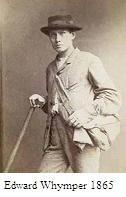
    It became an obsession for many, including Englishman Edward Whymper, a wood-engraver’s son. Whymper, an artist commissioned to make drawings of the Alps, wanted to become the first man on the summit. In July 1865 he ascended the easiest route, the Hornli Ridge, and stood atop the mountain, looking out over range upon range of mountains fading into the horizon, with freezing wind roaring in his face, and storm clouds racing overhead, and Zermatt tiny in the valley below.

    On the descent, four of seven men plunged down the face to their deaths. Charles Hadow, a Cambridge student, slipped on ice, unbalancing a Chamonix guide Michel Croz, which yanked a father and son, old and young Peter Taugwalder, both guides, as well as Charles Hudson and Lord Francis Douglas, leaving the entire party of seven hanging by a rope over an abyss.

    Whymper and two guides threw their weight into holding the others from falling and helped check the fall, but there the men hung, dangling as they watched the rope straining against all its weight.In 1865 pitons—spikes driven into rock to anchor sections of rope—had not yet been invented. The rope broke, and the lower four plunged to their deaths in a glacier almost a mile below. These were Croz, Hadow, Hudson, and Douglas. Except for Lord Douglas, all the bodies were later found. Today, the graves can be visited in a Zermatt cemetery.

    In 1931, the difficult north face was finally climbed by two unemployed brothers from Munich, Franz and Toni Schmid. At the 1932 Los Angeles Olympics, Art Competitions and Exhibition, Toni and Franz were awarded a Gold Medal, Merit for Mountaineering, for the first ascent of the north slope. Toni’s medal was posthumous. He died that same year, age 22, in a climbing accident seventy five days before the Games began. His brother Franz died in 1992, age 87.

    Even today, the Matterhorn counts among mountains having the highest number of deaths. Because of the many ascents since the 1950s, long lengths of fixed rope and ladders encourage more climbers than is safe. The traffic makes the mountain dangerous. Unlike Whymper’s time, today climbers on the Hornli ridge have the advantage of a hut, really a solid building, before the steep ascent on that slope. Farther on, they have the Solvay Hut, also well made. Despite these conveniences deaths are frequent. In August 1997, two Americans died climbing the Matterhorn from the Swiss side. That same year, an Idaho woman and a Californian died climbing it from the Italian. They fell to their deaths roped together on the East Ridge. Also in August 1997 seven other climbers died, including a 22 year old who fell into a crevasse and perished from exposure before climbers could reach him. In 2005, an Australian lost his footing and when his body was located he could not be identified because his head and face had been severely disfigured as he bounced off precipices and crags. In March of 2006 DNA confirmed his identity.

    Until his death in 1911, Edward Whymper grieved over his lost companions, never forgetting the tragedy of the very first Matterhorn ascent. For the would-be climber, his words remain true today. “Look well to each step; and from the beginning think what may be the end.”

    1/6/06

    Of Selves and Cars


    Of Selves and Cars

    In the 1 January 2006 article John Allen Paulos asserts that a major shift in society and culture would occur once the public widely understood that the self is non-existent. That is one view of the self. Only one.

    For thousands of years Buddhists and Hindus have asserted that the self does not exist. Disciples are taught to look for the self. The simplest Zen koan can be, Who am I? Once the disciple learns that the question cannot be answered in terms of a locus for the "I," he is on the road to enlightenment. Basically, the finding is supposed to be that the "I" cannot be found. Instead, there are various forms of sense impressions--thoughts, feelings, perceptions. The absence of solid evidence for self becomes hitched to a belief--that if nothing can be found, the self is an illusion and does not exist.

    Not necessarily so.

    Consciousness research has determined that, yes, self cannot be located in a single place. It does appear, but not as an objective unity. Several areas of the brain can produce several events, none of which coalesce into a single objective presence on, say, an fMRI brain scan. Still, we feel only one.

    The point: because a central, guiding self cannot be found does not mean that it is merely an illusion. When we look inwardly for the colonies of bacteria that digest our food we cannot find them. That does not mean they are illusory. Their presence is manifested by the fact of digestion. So, too, the self’s presence is manifested by its role in monitoring our activities. Even if we deny free will, we cannot deny the sense that something oversees our conscious affairs; this something can even participate in lucid dreaming.* We call it the self. It is part of the space that we call consciousness inside our head. Yet, if we looked inside the head, we would see only densely compacted grey matter, and no space. It and consciousness cannot be located but we believe both to be there.

    Black holes provide an analogy. We cannot see them, but can infer their presence by their affects on nearby space.

    As one example of the Eastern approach, advaita disciples learn that they cannot find the self by introspecting for it. Still, its absence does not imply that it is a creature of illusion. The inability to find it can be explained otherwise. It disappears under the flashlight of conscious focus. Try an experiment in perception. Stare at a blue dot lit against a yellow background. After a few minutes of focus the blue merges with the yellow. In Buddhist or Hindu meditation, the self dissolves into the background of consciousness. In Zen, this dissolution can initiate the experience of Big Mind, that one is a larger consciousness. But after the experience, self returns. Its earlier absence does not mean that it is illusory. In deep sleep, consciousness fades and self disappears but later returns.

    Were self a tag-along phenomenon, a chimera, it would not have evolved through natural selection to play its prominent role in our minds. It has survival value, whether as a monitor of activities, their agent, or both. This does not mean it has independent "reality"--only that it has a function as do eyes, fingers, and orgasms.

    Think of it this way. A tire is not a car. The steering wheel is not. Pistons are not. Put them all together and you have a car. You do not think of it as an illusion. Now imagine another situation. You sit on the couch. Drowsy, you dream a little. Then you awaken. You feel deep satisfaction at Mozart on the radio. You notice the cat purring on your lap. You think about a shopping list. You recall your boss's memo. With each of these, a different part of the brain "lights up," although if you had deliberately looked for a self you would not have found it. Yet you are aware of each event. Somehow, they harmonize into an "I" that is composed of them all. Although self is subjective, it gains explanations through comparison to a car. Even though the car is tangible as an object and self is intangible, the analogy is instructive once we allow that, for example, force at a distance (gravity) has an intangible "source," yet we recognize its affects.
    ______________________________
    *(Yes, the word is "sense," and sensations do not prove reality. Nor do they disprove it. You can look at your chair. Your view, your skin, and the weight of your body against the chair are only perceptions/sensations which may be only that, with nothing "beyond" them, not even the chair, but you assume the chair to have shaped them. You can disclaim the objective reality of the chair if you want, but that is another argument.)

    For thousands of years Buddhists and Hindus have asserted that the self does not exist. Disciples are taught to look for the self. The simplest Zen koan can be, Who am I? The disciple learns that the question cannot be answered in terms of a locus for the self.  It is that locus, that causes our problems. "They make me angry."  "I envy him."

    1/1/06

    The self is a conceptual chimera


    The self is a conceptual chimera

    John Allen Paulos says this about the self: "Doubt that a supernatural being exists is banal, but the more radical doubt that we exist, at least as anything more than nominal, marginally integrated entities having convenient labels like "Myrtle" and "Oscar," is my candidate for Dangerous Idea. This is, of course, Hume's idea — and Buddha's as well — that the self is an ever-changing collection of beliefs, perceptions, and attitudes, that it is not an essential and persistent entity, but rather a conceptual chimera. If this belief ever became widely and viscerally felt throughout a society — whether because of advances in neurobiology, cognitive science, philosophical insights, or whatever — its effects on that society would be incalculable. (Or so this assemblage of beliefs perceptions, and attitudes sometimes thinks.)"

    This is his answer to the annual question posed by Edge. For 2006 it is, What is the most dangerous idea of the year?

    Paulos is Professor of Mathematics, Temple University, Philadelphia and authored A Mathematician Plays the Stock Market, among other works.

    11/9/05

    Non-Duality’s No-Self and Antonio Damasio

    Antonio Damasio No-Self Non-Duality Zen Descartes' Error
    Non-Duality’s No-Self and Antonio Damasio

    Non-Duality is the term for a view of the world as not two, but one—not the duality of a person and the world outside him or her, but instead a subjective experience in which the perceiver and the perceived participate with one another in a sense, according to some experiencers, that all is part of incessant movement, a dance, so to speak. There is no experiencer, no experienced. All is experienc-ing. Everything is part of the subjectivity, with nothing outside. The view derives from Eastern belief, principally Hindu advaita, which literally means without duality and from Buddhism (Zen, for example).

    A central tenet of non-duality is that self—that which we call our self—does not exist. The evidence is offered by a methodology. The disciple is told to look for his self, and to do so relentlessly. Eventually, he concludes that he cannot find it. Only thoughts, feelings, and sensations are there. These are subjective—part of a world which is wholly conscious and without "external" objects. As for the chair in which he sits, all that is also subjective. The pressure of his body against the seat is sensation. His visual perception of it is also sensation. A sense of self-survival does not disappear. What fades eventually or vanishes abruptly is the autobiographical self, the sensation that "I am angry," or "I am upset," as examples. Sub-personalities remain. The predilection for mystery novels, as an example, does not go away. A liking of certain types of people remains. One still gets angry, etc, but the sensation passes quickly rather than lingering as fixed-cause for the autobiographical self ("They are always doing that to me.") Advaita and Buddhism have no problem with Damasio's arguments.

    The reader would be unwise to dismiss all this as so much balderdash. Quite able intellects, including philosphers George Berkeley and David Hume, have been unable to disregard conclusions they reached. Hume, for example, concluded as much about the self—that insufficient evidence can be found for its existence. Berkeley posited that nothing is material, and to be is to be perceivedEsse est percipi. Speaking only about self, Antonio Damasio has a different take on the situation. Damasio, M.D., Ph.D., currently is Allen Professor of Neurology, and Head of the Neurology Department at the University of Iowa. In Descartes’ Error* he offers another way to look at the phenomenon of the self. (* Subtitled, Emotion, Reason, and The Human Brain) As an example of his point, he refers to neural signals from the elbow joint. Of these signals he says, they


  • will happen in the early somatosensory cortices in the insular regions [of the brain].”

    Of them, he also states,


  • “Note again, that this is a collection of areas, rather than one center.”

    With this comment Damasio offers a point of view as to why the self cannot be found when we introspect for it, either through deliberate search or with meditation. We gain a simple inference from his remark. Introspection requires focus, and focus implies search for isolated neural phenomena. The self is not part of isolated phenomena. It is part of a collective. Picture the focused beam of a flashlight. Self cannot be found with such a search.

    By again referring to the early sensory cortices in the brain, he elaborates and makes an important observation regarding the self. First, the build-up to his comments on the self, then what he has to say about the self. In the build-up to his points, he explains that the early sensory cortices generate topographical representations. That is, the cortices represent sensory input to other areas of the brain. But if that were the end of it,

  • ”I doubt we would ever be conscious of them as images. How would we know they are our images? “

    He states that they would mean nothing to us, these representations. We would not know what to do with them. He says something would be missing, subjectivity—a subject to make meaning out of them. Something else is needed. Here is his first point:


  • “In essence, those neural representations must be correlated with those which, moment by moment, constitute the neural basis for the self. “

    That is, without a sense of self, they offer no utility for the organism, which must use them to survive in the moment or to plan ahead. It must make meaning out of them.

    He lays to rest the homunculus, the little man inside, the intermediary, which somehow bridged Descartes’ gap between mind and the world outside. His second point:

  • “Self is not the infamous homunculus, a little person inside our brain, perceiving and thinking about the images the brain forms. It is, rather, a perpetually re-created neurobiological state. Years of justified attack on the homunculus concept have made many theorists equally fearful of the concept of self. [Emphasis mine—he does not lend support to the no-self camp] But the neural self need not be homuncular at all. What should cause some fear, actually, is the idea of a selfless cognition.”

    In short, cognition cannot occur without a self to cognize things. Introspect, meditate, all you want but, according to Damasio, don’t use your findings as evidence of no-self. Given his explanation, the attempt to find a self implies cognition at work, with a self involved in the effort. Even though self cannot be found—because cognition involves focus and self is non-focused—the neural self is involved in the very attempt to find itself.

  • Damasio's thesis in Descartes' Error is that Rene Descartes mistakenly held that thinking can be separated from emotion. That can be found in Mind Shadows at Descartes' Error:Antonio Damasio, Somatic Markers, As-If Loops, and Moral Decision-Making, 11 April 2004.

    10/24/05

    Manufacturing Consent IX: The O'Reilly Fracture


    Manufacturing Consent IX: The O'Reilly Fracture

    The immensely profitable O'Reilly industry depends on the "credibility" of its guru, Bill O'Reilly. When Bill speaks, the public listens. A key money earner, for Fox News, he is a force to be reckoned with. What follows is the legal complaint for a sexual harassment lawsuit against him by a former Fox employee, Andrea Mackris. The entire document as well as other sordid O'Reilly matters can be found at The Smoking Gun


    10/19/05

    Manufacturing Consent VIII: European Public and Media

    Manufacturing Consent, European Public and Media, NBC News, Associated Press, Open Society Institute, TFI, Miklos Haraszti
    Manufacturing Consent VIII: European Public and Media

    Over the years this blog has followed the decline of good information and news analysis on which people can make critical judgments as citizens. It has noted that the major news outlets simply feed to the public what they receive. Various reasons exist for this sorry state of affairs. One is that corporate news organizations are more concerned with the bottom line than with any sense of responsibility to the public for investigative reporting or in-depth news analysis. They are driven by the competition for dollars, which has become increasingly fierce as international behemoths swallow newsrooms to make them part of a cash flow. (One of the biggest jokes is NBC News' "In-Depth" segment, which offers a few minutes to some cheesy topic, giving nothing but a tease and no depth at all.) The sense of corporate civic responsibility is being strangled by the need for survival.

    Certain types of blogs have become a feeble but--hopefully--rising voice for the public to learn about the skullduggery that goes on within the corridors of power. Unfortunately, there are so many of these blogs that one must become a news, politics, and policy junkie to keep up with all they provide. I go back decades and miss the era when a few major dailies could give much, if not all, of what an informed citizen should know. True, one can whittle down his reading to the most frequently visited sites, but even their number requires more time than my day offers.

    All of that is by way of preface to a growing global phenomenon. The death knell of news analysis and investigation isn't being sounded here in the USA only. We are faced with a frightening prospect--whole populations whose consent is being manufactured--as only one example--to unwittingly endorse wrong-headed policies that fatten the rich while diminishing the people's own income. Recently while traveling I found this news clipping from the St Louis Post-Dispatch. It is dated 11 October 2005:

    Associated Press. Europeans have nearly 4,000 television channels to choose from, but less and less quality programming to watch, according to a report by a European watchdog group.

    The report by the Open Society Institute said television remained the primary source of information for most Europeans even as programming is becoming less informative and more sensational.

    The institute analyzed television ownership content and regulations in 20 European countries, including 12 European Union member states, four EU candidate countries and four potential candidate countries.

    It found a drop in quality of news reporting in countries where a few companies often control a country's entire television market and those which have opened up quickly to a flood of commercial broadcasts.

    TFI, one of France's three commercial networks, commands almost one-third of the national audience and half of total TV ad revenue.

    "Investigative journalism and minority programming are hard to find," the institute said. "Viewers often do not receive the information necessary to make informed democratic choices."

    Miklos Haraszti, a media freedom expert, said a deluge of commercial channels in some countries has led to ratings wars with public service broadcasters. Haraszti is with the Organization for Security and Cooperation in Europe, a regional security organization.

    "The inevitable result has been the dumbing down of public service content in many countries," he said.

    The Open Society Institute, based in Hungary, said governments and international institutions should not let the market determine broadcasting policy. It recommended that the EU set up an independent agency to monitor media.

    Other Mind Shadows posts on the media:


    8/4/05

    Poppa Neutrino: 72 Year Old To Cross The Pacific On A Raft of Scraps


    Poppa Neutrino, David Pearlman, Random Lunacy, Scrap Raft, Triads of Them, Raft Atlantic, Raft Pacific
    Junk-Made Raft The Neutrino Family
    Crossed Atlantic on
    Poppa Neutrino was born in 1933 as David Pearlman in San Francisco. Twenty one years ago a dog bit his hand in Mexico, causing a two-year sickness so bad he thought he would die. Doctors were unable to diagnose his affliction. Finally recovered, he had changed, feeling so different that he decided on a new name. Poppa Neutrino is the first that came to him.

    He explains a neutrino this way:


  • According to science, neutrinos are subatomic particles that exist throughout the universe, are in constant motion, invisible but ever-present, and act as a sort of balancing factor to all visible matter. When we first read about neutrinos, no one had ever seen one, yet scientists were certain that they must exist. The human soul or spirit is also something that most people claim never to have seen, and so think does not exist. But if neutrinos exist and can't be seen, there must also be many other things that exist and can't be seen.

    Like himself, a neutrino is intinerant, its movement random, its course subject to its relationship within the system. In his seventy two years, Poppa Neutrino has not lived in one place over a year. With his "Floating Neutrinos," wife, children, and others, he set a trans-Atlantic record in a raft made of scraps. It was the first of its kind to make the voyage in the late 1990s.
    Poppa Neutrino, David Pearlman, Random Lunacy, Scrap Raft, Triads of Them, Raft Atlantic, Raft Pacific
    Poppa Neutrino in Baja California,
    Mexico. Raft to Cross
    Pacific

    With his dog, he now plans to cross the Pacific, also in a raft made of scraps. He recently left San Felipe, Baja California, bound for Peru, where he will attempt the voyage, done in 1948 by Thor Heyerdahl in a balsa wood raft.

    His life is guided by a world-view he explains as Triads Of Them, he has this to say:


  • The basic premise of this plan is that from the time you are born, you are being constantly programmed by outside forces - your parents, teachers, friends and relatives, and the society and culture you live in, through the media and the demands of school, work and laws. Most of these outside forces are acting on you in a mechanical way, giving pretty much the same programming to everybody. The programs of society, for example, are designed for the preservation of the society itself, not for individual self-fulfillment. 


  • Mind Shadow posts on Poppa Neutrino:  Poppa Neutrino Update & Chronology of Events, 15 September 2006; Poppa Neutrino: The Happiest Man In The World? 5 February 2009; Poppa Neutrino is Underway, 6 April 2006; Poppa Neutrino Is Dead, 19 May 2011.