Zimbardo's Stanford Prison Experiment and Abu Ghraib
With its obvious relationship to Abu Ghraib Prison, the Stanford Prison Experiment (1973) raises troubling questions about the ability of individuals to resist authoritarian or obedient roles required by social situations. Philip K. Zimbardo, professor of psychology, Stanford University, studied the process by which prisoners and guards become compliant or authoritarian. He placed an ad in a local newspaper:
In his essay on the experiment, Zimbardo has this to say: "When we planned our two-week-long simulation of prison life, we sought to understand more about the process by which people called ' prisoners' lose their liberty, civil rights, independence and privacy, while those called ' guards' gain social power by accepting the responsibility for controlling and managing the lives of their dependent charges. . . .
The sample of average, middle-class, Caucasian, college-age males (plus one oriental student) was arbitrarily divided by the flip of a coin. Half were randomly assigned to play the role of guards, the others of prisoners. . . .
The prisoners wore smocks and nylon stocking caps; they had to use ID numbers; their personal effects were removed and they were housed in barren cells. . . Their smocks, which were like dresses, were worn without undergarments, causing the prisoners to be restrained in their physical actions and to move in ways that were more feminine than masculine. The prisoners were forced to obtain permission from the guard for routine and simple activities such as writing letters, smoking a cigarette or even going to the toilet; this elicited from them a childlike dependency. . .
Guard M : ' I was surprised at myself . . . I made them call each other names and clean the toilets out with their bare hands; I practically considered the prisoners cattle, and I kept thinking, " I have to watch out for them in case they try something. " '
Guard A : ' I was tired of seeing the prisoners in their rags and smelling the strong odors of their bodies that filled the cells. I watched them tear at each other on orders given by us. They didn't see it as an experiment. It was real and they were fighting to keep their identity. But we were always there to show them who was boss.' . .
Prior to start of experiment :[Guard A :] ' As I am a pacifist and nonaggressive individual I cannot see a time when I might guard and/or maltreat other living things.' . .
Fifth Day : [Guard A : ] ' I have singled out [a prisoner] for special abuse because he begs for it and because I simply don't like him. . . I walk by and slam my stick into the Hole door . . . I am very angry at this prisoner for causing discomfort and trouble for the others. I decided to force-feed him, but he wouldn't eat. I let the food slide down his face. . . .[Several guards were involved in the abuse, but Guard A is used here because he serves to track the change in one individual.]
The potential social value of this study derives precisely from the fact that normal, healthy, educated young men could be so radically transformed under the institutional pressures of a 'prison environment' . If this could happen in so short a time, without the excesses that are possible in real prisons, and it could happen to the ' cream-of-the-crop of American youth,' then one can only shudder to imagine what society is doing both to the actual guards and prisoners who are at this very moment participating in that unnatural 'social experiment'." ( Excerpted from Philip K. Zimbardo, "The Mind Is A Formidable Jailer," The New York Times Magazine, 8 April 1973. )
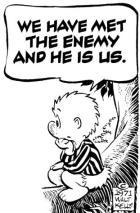
My Comment: I fully condemn the abuse of the Iraqi prisoners and do not offer Zimbardo in defense of the abusers. Zimbardo's experiment is provided as a reminder that we should not piously mouth that we would not do such a thing. More than pieties are required. We must think about and plan for the challenges to our character and integrity. Zimbardo cautions us against smugness.