AddThis

Showing posts with label Werner Heisenberg. Show all posts

8/22/06

David Chalmers and The Hard Problem of Consciousness


David Chalmers and The Hard Problem of Consciousness

Form is emptiness, emptiness form. (The Heart Sutra)

Existence occurs at the merger between form and emptiness. In Buddhism, this situation is expressed by the Heart Sutra. In Advaita, it is called Awareness. In either case, emptiness recognizes itself as what arises within it. Those are merely words but are the best language can do although the subject has no doubt of what they signify, the foundation of conscious life.

This realization goes to the core of "The Hard Problem of Consciousness," as termed by David Chalmers. (Among various explanations of it as a problem one is, Why do you have such a rich inner life?) Those who research and think about consciousness cannot truly understand the Hard Problem without this realization.

Daniel Dennett explains it all away by saying Chalmers' proposal is a non-problem. Dennett, though, is a proselytizer at base. He doesn't engage issues that do not fit his agenda. Instead, his strategy is often to downplay the opposition.

The realization of true issues surrounding The Hard Problem cannot occur without "experiential expertise." That is, it will remain inaccessible so long as there is insistence on a level playing field--tools, techniques, and concepts available to everybody engaged in consciousness philosophy and research.

One might argue that this experiential expertise does not fit the scientific model in that the solution cannot be assessed, falsified, or verified by a community of peers. That is not the case. The community of peers need not be a democracy--that is, a large pool of peers. The Special and General Theories of Relativity are still not profoundly understood by most physicists.

The discussions and debates about The Hard Problem of Consciousness will continue, but the real field of study is at hand, and those who don't see it are rather like the boy who proclaimed that the emperor had no clothes.

Like quantum theorists with the findings of people such as Heisenberg, Schrödinger, and Bell, perhaps the consciousness community will eventually develop consensus that the standard concepts and techniques simply can not yield an answer to The Hard Problem. In the meantime, let us hope that a few will take an approach considered to be slumming by some of their peers.

I refer to an intensive skeptical search (not this, not that), probably lengthy, for who they are by using a Dzogchen Buddhist or Advaitan discipline--while separating wheat from the chaff of teachings until--as supposedly phrased by St Francis of Assisi--they find out that they are what is being looked for, and this realization takes over their lives, both as a contributing peer and as a private person. It is not spiritual. It is not religious. It simply is.

1/2/04

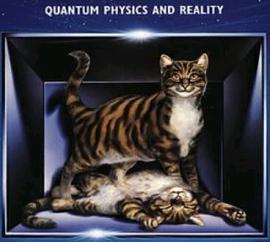
Superposition Theory: How Can Schrödinger's Cat Be Neither Alive Nor Dead?


Superposition Theory: How Can Schrödinger's Cat Be Neither Alive Nor Dead?

A brief tour through the land of the truly strange.beheld the strangeness, didn't doubt that it had been found as described, but proposed his cat to illustrate the absurdity of the findings.

Assume a shield with two slits in it, and a wall behind. Fire bullets one at a time through each slit. The outcome? That the wall directly behind the slits becomes speckled with bullet holes. This should also work at the quantum level. Right? Wrong.

Now, smaller than normal microscopes can see, at the quantum level, shoot light particles, or photons, one at a time through each slit. What happens? Each photon goes through both slits at once. Imagine a bullet going through both slits at the same time. It's impossible. But photons do. "Transforming" from particles into waves, the photons demonstrate an Interference Effect, showing that photons have been everywhere simultaneously. They have superpositioned, taking every possible trajectory to reach the target. This happens not only in theory, but in fact.

How can this be? How can they be both particle and wave? How can they travel all possible routes simultaneously? To find out, researchers measure (track) the paths of individual photons. What happens? They cannot "snapshot" the simultaneous trajectories. Measurement disrupts the trajectories, causing wavefunction collapse, which is to say the experimenter no longer can measure all those possible outcomes, but only has one. (Studied by Neils Bohr and Werner Heisenberg, they provided the Copenhagen Interpretation.)

At the normal human level of perception it is like saying a cat is neither alive nor dead before looking at it. Enter: Schrödinger, who took his cat into the realm of metaphysics.

In 1935 Schrödinger proposed a thought experiment. It is now referred to as Schrödinger's Cat.

Imagine a closed box containing a live cat and a vial with poison. A Geiger counter detects radioactive decay of an atom, with equal probability that in one hour the atom decays or it does not. If decay occurs, then a hammer breaks the vial glass, the poison thereby killing the cat.

Now, the problem is that physicists are confronted with two seemingly different levels of reality. The first is the so-called gravitational world in which our daily lives occur. The second is the quantum level, in which weird things happen.

In the everyday world a fifty/fifty chance exists that the cat will be killed. Without looking in the box, we can speak of equal probability that the cat is either alive or dead.

Things aren't that easy on the quantum level. According to quantum theory, the fifty/fifty chance doesn't apply. It tells physicists that they cannot make such assumptions.

Quantum theory holds that atomic decay has neither happened nor not happened. The cat has neither been killed nor not killed. The cat is neither alive nor dead until somebody takes a look at it. How can this be? That's just the way it is. As in wavefunction collapse, the experimenter cannot know until he looks inside the box to see what has happened. Nothing can be known until observation occurs. *

Both at the same time? In terms of the world on the quantum level, the object of observation is both wave and particle until measured, when it is forced to determine its state, wave or particle.

Something is wrong here, one might say. Something about this situation is being omitted. Quite right. Consider that somehow the observer may interact with the observed. (Like your mind making one bullet go through two slits at once.) Consciousness itself may be that which is left out of the equation.

In 1982, Alain Aspect at the University of Paris-South sought an underlying resolution. For purposes of this article, think of his experiments as looking for reality. Why? Because with an underlying reality, photons will have "inherent" polarization before they are emitted. In other words, unlike Schrödinger's theoretical cat, they cannot be potentially both one and the other, alive and dead. (See John Bell's Inequality Theorem, & Alain Aspect's experiments, 10 November.)

Aspect's experiments did not find any such underlying resolution. Instead, they supported the prevailing Superposition Theory. The measurement made on one photon affected the polarization of the other. Polarization was affected after photons were emitted. This implied that they had no inherent polarization.

One can also infer that such particles seem inseparably connected as a whole, each aware of what happens to the others.

In another area of investigation, Professor of psychiatry Arthur Deikman, University of California, has tapped into a Hindu view. He posits that in Consciousness an "I-AM" is the same as our consciousness, and is also differentiated from our individual physical and mental person.** Although our experience is dualistic, it is a dualism of the observing "I" and the observed contents of its consciousness. The observer interacts with the observed. **(Notice that your body ages, time passes, yet an awareness in you does not age.Something feels the same although everything perceived changes. See Perception, 8 December.)

Of course Deikman's view, experiencing "I-AM," almost certainly will not find its way into a testable approach, but that does not mean it is false; it only means that what we experience can be wholly other than what we theorize or implement. Like Schrödinger's Cat, with each measurement, each time a wavefunction collapses, physicists verify this difference as a fact of life.

Later in life Schrödinger wished he had never met his cat.
__________________________________
*Why can't we understand what is happening? One theory posits a wave function collapse in the human brain, made necessary in order to survive in our evolution. Another has many worlds occuring simultaneously (the simultaneous photon trajectories), and as we live in only one, we can only measure one of the trajectories.

Home

12/31/03

Memes, Genes, and God

Memes, Genes, and God


Originally proposed in Richard Dawkins' book, The Selfish Gene, 1976, memes can be defined as any self-referential belief system with inherent instructions for its own propagation. As Dawkins explained, they can be "tunes, ideas, catch-phrases, clothes fashions, ways of making pots or of building arches. Just as genes propagate themselves in the gene pool by leaping from body to body via sperms or eggs, so memes propagate themselves in the meme pool by leaping from brain to brain via a process which, in the broad sense, can be called imitation. . . . . As [Dawkins'] colleague N.K. Humphrey neatly summed up . . . 'Memes should be regarded as living structures, not just metaphorically but technically'."

Memes are analogues for genes, which is to say they are analogues for natural selection. The two may reinforce one another or come into competition. Celibacy is a meme but as a gene has no biological survival value, although culturally it may have such value. Priests or nuns transmit the meme to young boys or girls who are trying to make a life choice. Suppose the celibacy meme made better priests and nuns because they are not distracted by family duties. If this supposition is true, then celibacy does have better cultural survival value. On the other hand, a gene for celibacy almost by definition would not produce celibate offspring. Rather, no offspring would ensue from it.

Like genes, memes rest on one fundamental principle. All life evolves by varying survival abilities of replicating entities.

When we die we leave behind memes and genes. Of the two, our genes will be forgotten in three generations. Our child, maybe our grandchild, can bear a resemblance to us in face or musical talent, but our characteristics soon become negligible in succeeding generations. If we have memes such as Shakespeare's we become part of deathless literature. The same can be said for Einstein, Socrates, or Leonardo da Vinci.

Dawkins and other meme theorists regard religious memes as dangerous to human futurity. The idea of God is a particularly strong meme, and has persisted from before recorded history until the present day. It has extremely high survival value. According to Dawkins, its survival results from its psychological appeal. He says that it "provides a superficially plausible answer to deep and troubling questions about existence. It suggests that injustices in this world may be rectified in the next. . . . God exists, if only in the form of a meme with high survival value, or ineffective power, in the environment provided by human culture."

Here, Dawkins is bent by his Western understanding. Some, as in Christianity and Islam, claim to have the one true meme. It and it alone must be propagated at the risk of damnation by God. He doesn't understand that Buddhist memes make no claim to exclusivity and Hindu memes espouse tolerance.

When Dawkins says religious memes provide "a superficially plausible answer to deep and troubling questions about existence," he reveals a rather rudimentary understanding. Superficially plausible? Without Dawkins' intensive study, meditation, and effort, Buddha's teachings would not be immediately accessible to him because Buddha speaks of the quality of various experiences. Science tends to ignore the qualities of experiences and assumes all experience to be the same for its purposes. Once studied, pondered, and filtered through life experiences, the implications of Buddha's teachings open an entirely new way of seeing, one which reveals the flaws in conventional world views, particularly those which assume all experience is equal and only objective observation is necessary. Those views are superficial. (See the discussion of experience quality in Cartesian anxiety: Francisco Varela, 6 January.)

Dawkins would attach little or no credence to people such as Nisargadatta, Ramana Maharshi, or medieval Germans, Meister Eckhart or Jacob Boem as they all spoke about what might be called the "God meme." The single interesting facet of their contribution has much to do with all memes, however.

Each of them, Nisargadatta, Maharshi, Eckhart, and Boem, said that human beings can reach a point when mimesis is realized as empty phenomena. That is, they observed that the mind replicates as its natural function, but that this replication can be seen through.

This implies that the "God meme" has a basis not in superstition, but in an intuitive, innate human recognition, a recognition that mimetics derives from the source of all memes. To determine that, of course, Dawkins and others must learn attitudes, mental skills and concentration currently unknown to them; they must stop theorizing and immerse themselves in an initially alien perspective in order to experience directly whether the "God meme" is superstition or not.

From memes to genes. Dawkins would have no problem if I said that individual organisms, "selfish" or not, reveal a compulsion to perpetuate their genes and that this compulsion is a dynamic of biological regularities not apparent in an isolated system. The dynamic cannot be described in terms of DNA biochemistry. In fact, no definitive explanation can be found in any isolated system. Yet we observe among organisms the selfish gene, as Dawkins calls it.

Would he have a problem if I replace "a compulsion to perpetuate their genes" with a phrase about a compulsion to seek God? The only difference between accepting one statement and rejecting the other is not logic but mind set.*
____________________________________
* ". . . I have never found it possible to dismiss the content of religious thinking simply as simply part of an outmoded phase in the consciousness of mankind. . ." Werner Heisenberg, Physics and Beyond

Meme theory is not a science, nor at present has much chance of becoming one, although it does provoke stimulating and lively discussion.

12/12/03

John Horgan, Scientific American Writer, on Daniel Wegner and Free Will


John Horgan, Scientific American writer, on Daniel Wegner and free will

"When I woke this morning, I stared at the ceiling above my bed and wondered: to what extent will my rising really be an exercise of my free will? Let's say I got up right . . . now. Would my subjective decision be the cause? Or would computations unfolding in a subconscious neural netherworld actually set off the muscular twitches that slide me out of the bed, quietly, so as not to wake my wife, and propel me toward the door? . . . "

"[According to Dr Daniel M Wegner, Harvard psychologist, the chief offender is the Illusion of conscious will.] What makes Dr. Wegner's critique more effective than others I've read over the years is that it is less philosophical than empirical, drawing heavily upon recent research in cognitive science and neurology. . . . "

"We think of will as a force, but actually, Dr. Wegner says, it is a feeling — "merely a feeling," as he puts it — of control over our actions. I think, "I'm going to get up now," and when I do a moment later, I credit that feeling with having been the instigating cause. But as we all know, correlation does not equal causation. . . . Wegner calls the idea of free will intention invention." More
_____________________________
In regard to what Horgan says about Wegner, think about this. In 1927, puzzled by the behavior of quantum particles, Werner Heisenberg wrote, "The ‘path’ comes into existence only when we observe it." (Also click here for my 8 November article on Benjamin Libet's pioneering experiments which have free will implications.)

A founder of modern physics, Heisenberg questioned the classical view of an objective observer. We can also say the paths of our lives do not exist until observed. As concept, a determined future assumes an objective observer. If we cannot know the perceiver, how can there be an objective observer? How, then, can one ever say that the future is predetermined? Read the 8 December article on Perception.

11/10/03

Looking for Reality: Billiard Balls, Einstein, and Nisargadatta


Looking for Reality: Billiard Balls, Einstein, and Nisargadatta

A billiard ball strikes another and moves it across the table. The proximity of the one effected a change in the second. Right?

Einstein said so. He, of course, took it further and asserted that the speed of light is an absolute, a constant, that determines physical effects, none of which can be transmitted faster than its own speed, 300,000 kilometers per second (186,000 miles per second). Things happen locally, not across great distances, he added. Although Einstein didn't put it in the same manner, his principle also holds that when nobody is in a forest to hear a tree fall, there is sound nonetheless.

Then along came Quantum Theory and a physicist named Werner Heisenberg who challenged Einstein's theory. Einstein's view had reality as something with falling trees making sounds, and particles giving simultaneous position and velocity--something like a car crossing a railroad track at twenty miles an hour. (This is not a good comparison, but it helps impart the idea of position and velocity.) Heisenberg found that he couldn't have it both ways. He could either "snapshot" a particle's velocity or its position, but not both, which is akin to saying that we can describe that the car travels at twenty miles an hour or that it crosses a railroad track, but not both. On the quantum level the world simply didn't behave as Einstein conceived it on the large, gravitational level.

The point here: if things happen locally, if the local implies the real, then why can't both position and velocity be described at the quantum level?

Things happen locally?, somebody might ask, then reply, Why of course they do. Reality is based on conditions right in front of us. Things, and the conditions for an event, can't happen anywhere else but where we see an occurrence. Right?

Not necessarily.

John Bell had problems with this. In 1965 he wanted to determine whether reality could be described by a theory supporting local variables. For this purpose he developed an Inequality Theorem. This didn't work as it, too, implied non-locality. Subsequent experiments by other physicists indicated that reality, if there is one, cannot be local. (This, of course, comes as no surprise to a Zen master who teaches Big Mind, or a Hindu sage who speaks of Consciousness with a capital C. That art thou, as an ancient Sanskrit saying has it.)

In 1982, Alain Aspect conducted experiments at the University of Paris-South to determine if reality is non-local. His photon detectors were forty feet apart (12 meters) in order to record events at Track X and Track Y, sufficiently distant from one another. For purposes of this explanation, here is a key element of his experiments:


  • They were measured so that they could not "talk" to one another across Tracks X and Y. (Thus if reality is local, then the photon in Track X is independent of that in Track Y.)

    What implications for the outcome? If reality is local, then measuring the photon in X would have no effect on measurement of the photon in Y. If non-local, then measurement at X can affect measurement at Y.

    What did Aspect discover? That measurement at X affected measurement at Y. The findings imply that Einstein was wrong about locality and that the speed of light may be irrelevant to some events, or (horror! heresy!) something there is which travels faster than light. In any event, reality is non-local.

    A humble Indian merchant, Nisargadatta, had a different view of the entire matter. This is how he put it in I Am That:

    "There is no such state as seeing the real. Who is to see what? You can only be the real, which you are, anyhow. The problem is not mental. Abandon false ideas, that is all. There is no need of true ideas. There aren't any. " (359-60)