![]()

 Superposition Theory: How Can Schrödinger's Cat Be Neither Alive Nor Dead?
A brief tour through the land of the truly strange.beheld the strangeness, didn't doubt that it had been found as described, but proposed his cat to illustrate the absurdity of the findings.
Assume a shield with two slits in it, and a wall behind. Fire bullets one at a time through each slit. The outcome? That the wall
directly behind the slits becomes speckled with bullet holes. This should also work at the quantum level. Right? Wrong.
Now, smaller than normal microscopes can see, at the quantum level, shoot light particles, or photons, one at a time through each slit. What happens? Each photon goes through
both slits at once.
Imagine a bullet going through both slits at the same time. It's impossible. But photons do. "Transforming" from particles into waves, the photons demonstrate an Interference Effect, showing that photons have been
everywhere simultaneously. They have
superpositioned, taking every possible trajectory to reach the target. This happens not only in theory, but in fact.
How can this be? How can they be both particle and wave? How can they travel all possible routes simultaneously? To find out, researchers measure (track) the paths of individual photons. What happens? They cannot "snapshot" the simultaneous trajectories. Measurement disrupts the trajectories, causing
wavefunction collapse, which is to say the experimenter no longer can measure all those possible outcomes, but only has one. (Studied by
Neils Bohr and Werner Heisenberg, they provided the
Copenhagen Interpretation.)
At the normal human level of perception it is like saying
a cat is neither alive nor dead before looking at it. Enter: Schrödinger, who took his cat into the realm of metaphysics.
In 1935 Schrödinger proposed a thought experiment. It is now referred to as
Schrödinger's Cat.
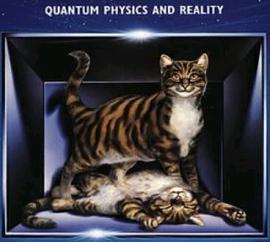
Imagine a closed box containing a live cat and a vial with poison. A Geiger counter detects radioactive decay of an atom, with equal probability that in one hour the atom decays or it does not. If decay occurs, then a hammer breaks the vial glass, the poison thereby killing the cat.
Now, the problem is that physicists are confronted with two seemingly different levels of reality. The first is the so-called gravitational world in which our daily lives occur. The second is the quantum level, in which weird things happen.
In the everyday world a fifty/fifty chance exists that the cat will be killed. Without looking in the box, we can speak of equal probability that the cat is either alive or dead.
Things aren't that easy on the quantum level. According to quantum theory, the fifty/fifty chance doesn't apply. It tells physicists that they cannot make such assumptions.
Quantum theory holds that atomic decay has neither happened nor not happened. The cat has neither been killed nor not killed. The cat is neither alive nor dead until somebody takes a look at it. How can this be? That's just the way it is. As in wavefunction collapse, the experimenter cannot know until he looks inside the box to see what has happened. Nothing can be known until observation occurs. *
Both at the same time? In terms of the world on the quantum level, the object of observation is both wave and particle until measured, when it is forced to determine its state, wave or particle.
Something is wrong here, one might say. Something about this situation is being omitted. Quite right. Consider that
somehow the observer may interact with the observed. (Like your mind making one bullet go through two slits at once.) Consciousness itself may be that which is left out of the equation.
In 1982,
Alain Aspect at the University of Paris-South sought an underlying resolution. For purposes of this article, think of his experiments as looking for reality. Why? Because with an underlying reality, photons will have "inherent" polarization before they are emitted. In other words, unlike Schrödinger's theoretical cat, they cannot be potentially both one and the other, alive and dead. (See
John Bell's Inequality Theorem, & Alain Aspect's experiments, 10 November.)
Aspect's experiments did not find any such underlying resolution. Instead, they supported the prevailing Superposition Theory. The measurement made on one photon affected the polarization of the other. Polarization was affected after photons were emitted. This implied that they had no inherent polarization.
One can also infer that such particles seem
inseparably connected as a whole, each aware of what happens to the others.
In another area of investigation, Professor of psychiatry
Arthur Deikman, University of California, has tapped into a Hindu view. He posits that in Consciousness an "I-AM" is the same as our consciousness, and is also differentiated from our individual physical and mental person.** Although our experience is dualistic, it is a dualism of the observing "I" and the observed contents of its consciousness. The observer interacts with the observed. **(Notice that your body ages, time passes, yet an awareness in you does not age.
Something feels the same although everything perceived changes. See
Perception, 8 December.)
Of course Deikman's view, experiencing "I-AM," almost certainly will not find its way into a testable approach, but that does not mean it is false; it only means that what we experience can be wholly other than what we theorize or implement. Like Schrödinger's Cat, with each measurement, each time a wavefunction collapses, physicists verify this difference as a fact of life.
Later in life Schrödinger wished he had never met his cat.
__________________________________
*Why can't we understand what is happening? One theory posits a wave function collapse in the human brain, made necessary in order to survive in our evolution. Another has many worlds occuring simultaneously (the simultaneous photon trajectories), and as we live in only one, we can only measure one of the trajectories.
Home