AddThis

Showing posts with label Nonduality. Show all posts

7/3/18

Seeing Through Self: David Bohm & Krishnamurti's Ego


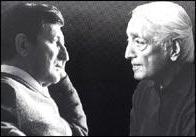
Quantum physicist David Bohm (1917-1992) was a protégé of J. Robert Oppenheimer and liked by Einstein. So impressed was Einstein, that he referred to Bohm as his successor. As for Bohm, he had deep interests outside science. This led to the day when Bohm met J. Krishnamurti and began studying under him until the two men had a falling-out.

4/3/18

No-Self, Antonio Damasio, and NonDuality


Non-Duality is the term for a view or experience of the world as not two and not even one—not the duality of a person and the world outside him or her, but instead that which is neither subject nor object nor a  unity.  The term derives from Eastern teachings, principally Hindu advaita, which literally means without duality. It also finds support in Buddhism (Zen, for example, in which the Heart Sutra declares that form is emptiness, emptiness form). The teachings are that we live in nonduality right now and we can find out for ourselves but not through intellect. (Zen koans are designed to teach the futility of intellect and reason in understanding it.)

A central tenet of non-duality is that self—that which we call our self—does not exist. The evidence is offered by a methodology.

8/30/11

The DNA Evidence for Nonduality

Bookmark and Share
Faces along the bar
Cling to their average day:
The lights must never go out,
The music must always play,
All the conventions conspire
To make this fort assume
The furniture of home;
Lest we should see where we are,
Lost in a haunted wood,
Children afraid of the night
Who have never been happy or good.
(September 1, 1939, by W.H. Auden)

And the world continues on its mad way, while occasionally a few begin to question their quiet desperation and ask, What else? There is nothing else. It's all right here. You are what you are looking for, as St. Francis said. Or, what you are looking for is not behind you, as Jean Klein quipped. When this is realized, when only that day dawns to which we are awake, as Thoreau put it, life changes for the better.

That is not so much mystical mumbo-jumbo. The understanding is available as you go about the bustle of your daily life.

A scientific slant on what I mean can be found in the material below. But I provide this because it is not just about DNA; it is about you. DNA is an object, something observed as a word in print or thought, or under a fluorescence microscope. You are not an object.

Richard Dawkins, apostle of materialism and atheism, argues that DNA uses organisms to perpetuate itself and that we exist to serve it. That is, he means we are objects, you and I, and he is big-hearted enough to include himself among us. Although his The Selfish Gene is a brilliantly clever book, it manipulates evidence, as Mary Midgley has noted. Here is a counterpoint to his view. The author I quote, John Stevenson*, speaks outside the centuries-entrenched scientific paradigm, and with regard to DNA and deathless one-life he has this to say:

~Tradition is very strong in human thinking. A lifetime of learning that life consists of being born, having offspring and then dying produces a mind set. Relationships within families such as sister, mother, father, etc. are fundamental in our thinking. A human, we believe, is an individual, another human is a separate life. Conclusion 5 presents an entirely different story. It says that all life in all living things is the same life. This violates all previous teachings about life.

8/23/11

A Stillness Arose As Artillery Shells Exploded

Bookmark and Share
This is the true story of William Samuel, a Captain of Infantry, who in the midst of hellish, fierce, and bloody combat, found spiritual peace, an "immeasurable calm" and understanding of "the deathlessness of Life." A new life, his, was born from the carnage.

5/11/04

Amit Goswami Physicist on Enlightenment Plus Jesus in Beijing


Christianity in China
Chinese Jesus Nativity Scene
Jesus In Beijing; Physicist's Guide to Enlightenment; Knowledge Web

Jesus in Beijing. David Aikman's new book is Jesus in Beijing (Regnery). Aikman, the former Beijing bureau chief for Time magazine, charts admirably the fascinating, mercurial, and sometimes sadly instructive history of the Christian evangelization of China. It is a story of remarkable men and women: heroes, martyrs, eccentrics, and, yes—as elsewhere—dismal, even disgraceful heretics and apostates.

The Nestorian Christians—whose descendents are the Assyrian churches of Iraq—arrived in A.D. 635. Aikman traverses the subsequent history, ending with an analysis of the startling missionary vision of millions of Chinese Christians of the 21st century: to wend their way along the old Silk Road, gathering in the churches, converting the Muslims as they go, and then at last "to preach the gospel in Jerusalem." He includes superb mini-biographies of some of the most important historical figures and house-church leaders of the past half-century, as well as of dynamic current leadership. Jesus in Beijing at Christianity Today 


  • The Visionary Window: A Quantum Physicist’s Guide to Enlightenment, by Amit Goswami (2000, Quest).Most scientists today do science for career motives. Many who dream of a paradigm shift want to discover that one new idea that will bring them instant fame and fortune. The paradigm that integrates science and spirituality is not based on a new idea. Thus these scientists are reluctant to accept that the “new” idea for the paradigm they seek—the idea that “consciousness is the ground of all being”—has been around for millennia. Yet once one sees the validity of this idea, the authenticity of the quantum window also becomes clear. To appreciate the primacy of consciousness a scientist must investigate consciousness directly. Not with concepts, not only with public experiments in experimental metaphysics (important as these are), but also through direct experience. “Consciousness is closer than our jugular vein,” said the great sheik Ibn Arabi. We have to look at ourselves.

    Traditional science demands from its practitioners strict objectivity: scientists must not become subjectively involved with their field; that is they may change the field of their practice, but they must not allow their research to change them. One must argue compellingly for scientists of the new science to radically extend their methodology in this regard. . . . . Scientists will continue to miss the very profound insight that consciousness is the ground of all being if they don’t delve into transformation. . . . .

    The point is that the transformation in experience which the scientist would undergo while exploring consciousness is essential for the kind of direct and deep insight required to gain knowledge of the psyche. Without that, the scientist would be blind to the phenomena and processes under investigation. Such “inner vision” is the starting point—the sina que non—of any true consciousness science; it is the source of data which, later, the scientist can build into a communicable model. 

  • The knowledge web. With the knowledge web, humanity's accumulated store of information will become more accessible, more manageable, and more useful. Anyone who wants to learn will be able to find the best and the most meaningful explanations of what they want to know. Anyone with something to teach will have a way to reach those who what to learn. Teachers will move beyond their present role as dispensers of information and become guides, mentors, facilitators, and authors. The knowledge web will make us all smarter. The knowledge web is an idea whose time has come.