John Bell said there was no mystery in Albert Einstein's Hidden Variables. In the 1935 Einstein-Podolsky-Rosen Paradox, the four scientists posited that spooky action at a distance --nonlocal interaction of objects spatially separated-- could be explained by Hidden Variables. That is, two entangled particles could affect one another though light years apart, and this mutual influence was due to something hidden from observation. In 1981 John Bell said it could be explained by the socks on his friend's feet.AddThis
Showing posts with label John Bell. Show all posts
6/4/13
Spooky Action at a Distance & Reinhold Bertlmann's Socks
John Bell said there was no mystery in Albert Einstein's Hidden Variables. In the 1935 Einstein-Podolsky-Rosen Paradox, the four scientists posited that spooky action at a distance --nonlocal interaction of objects spatially separated-- could be explained by Hidden Variables. That is, two entangled particles could affect one another though light years apart, and this mutual influence was due to something hidden from observation. In 1981 John Bell said it could be explained by the socks on his friend's feet.9/30/10
Spooky Action At A Distance & Reinhold Bertlmann's Socks
John Bell said there was no mystery in Albert Einstein's Hidden Variables. In the 1935 Einstein-Podolsky-Rosen Paradox, the four scientists posited that spooky action at a distance could be explained by Hidden Variables. That is, two entangled particles could affect one another though light years apart, and this mutual influence was due to something hidden from observation. In 1981 John Bell said it could be explained by the socks on his friend's feet.8/22/06
David Chalmers and The Hard Problem of Consciousness
Form is emptiness, emptiness form. (The Heart Sutra)
Existence occurs at the merger between form and emptiness. In Buddhism, this situation is expressed by the Heart Sutra. In Advaita, it is called Awareness. In either case, emptiness recognizes itself as what arises within it. Those are merely words but are the best language can do although the subject has no doubt of what they signify, the foundation of conscious life.
This realization goes to the core of "The Hard Problem of Consciousness," as termed by David Chalmers. (Among various explanations of it as a problem one is, Why do you have such a rich inner life?) Those who research and think about consciousness cannot truly understand the Hard Problem without this realization.
Daniel Dennett explains it all away by saying Chalmers' proposal is a non-problem. Dennett, though, is a proselytizer at base. He doesn't engage issues that do not fit his agenda. Instead, his strategy is often to downplay the opposition.
The realization of true issues surrounding The Hard Problem cannot occur without "experiential expertise." That is, it will remain inaccessible so long as there is insistence on a level playing field--tools, techniques, and concepts available to everybody engaged in consciousness philosophy and research.
One might argue that this experiential expertise does not fit the scientific model in that the solution cannot be assessed, falsified, or verified by a community of peers. That is not the case. The community of peers need not be a democracy--that is, a large pool of peers. The Special and General Theories of Relativity are still not profoundly understood by most physicists.
The discussions and debates about The Hard Problem of Consciousness will continue, but the real field of study is at hand, and those who don't see it are rather like the boy who proclaimed that the emperor had no clothes.
Like quantum theorists with the findings of people such as Heisenberg, Schrödinger, and Bell, perhaps the consciousness community will eventually develop consensus that the standard concepts and techniques simply can not yield an answer to The Hard Problem. In the meantime, let us hope that a few will take an approach considered to be slumming by some of their peers.
I refer to an intensive skeptical search (not this, not that), probably lengthy, for who they are by using a Dzogchen Buddhist or Advaitan discipline--while separating wheat from the chaff of teachings until--as supposedly phrased by St Francis of Assisi--they find out that they are what is being looked for, and this realization takes over their lives, both as a contributing peer and as a private person. It is not spiritual. It is not religious. It simply is.
7/22/05
David Chalmers' Book The Conscious Mind
David Chalmers' Book The Conscious Mind and The Hard Problem
Although called the father of modern philosophy, René Descartes became challenged in the last century for the split he created between body and mind, the mind-body dualism, or subject and object. For him, body became one thing; mind, another. This presents a problem. Why? Hold out your hand. Open the fist. Now close it. How did the gap get bridged between your hand, the object, and mind, the subject, if the two are split? Yet, the one and the other are somehow in relationship. This is one problem for understanding consciousness and it implicates other problems. In particular, David Chalmers has become widely-known and quoted for a key issue he presents to philosophers and neuro-researchers in the field.
Well-known for his phrase on the "hard problem," as in the article title above, Chalmers’ ideas can be found in his The Conscious Mind: In Search of A Fundamental Theory, among other books. In that work, he puts the hard problem in this manner: "Why is all this processing accompanied by an experienced inner life?" Put differently, he seeks an objective explanation for subjective experience. Some would argue that he can't get there from here--"here" being subjectivity. They would say that physical models can help elucidate consciousness processes, but ultimately "what it feels like to be me" cannot be explained. I am one of them. Still, he offers an interesting and intelligent discussion. Here is part of it.
He introduces processing this way: “Many books and articles on consciousness have appeared in the past few years, and one might think that we are making progress. But on a closer look, most of this work leaves the hardest problems about consciousness untouched. Often, such work addresses what might be called the ‘easy’ problems of consciousness: How does the brain process environmental stimulation? How does it integrate information? How do we produce reports of internal states? But to answer them is not to solve the hard problem: Why is all this processing accompanied by an experienced internal life?”
The problem is compounded by the term consciousness. It is rather slippery and must be handled with care. He observes that sometimes it refers to
- “cognitive capacity, such as to introspect or to report one’s mental states;
- “awakeness”;
- “our ability to focus attention and to voluntarily control behavior”;
- “to know about something.”
He points out that each of these are “accepted uses of the term, but all pick out phenomena distinct from the subject I am discussing, and phenomena that are significantly less difficult to explain.” When he refers to consciousness he means “the subjective quality of experience; what it is like to be a cognitive agent.”
That is truly a hard problem.
Not satisfied with Daniel Dennett’s explanations (Consciousness Explained, Elbow Room, and other titles), he has this to say: "Dennett spends much of his book [Consciousness Explained] outlining a detailed cognitive model, which he puts forward as an explanation of consciousness. On the face of it, the model is centrally a model of the capacity of a subject to verbally report a mental state. It might thus yield an explanation of reportability, of introspective consciousness, and perhaps of other aspects of awareness, but nothing in the model provides an explanation of phenomenal consciousness. . . . "
Note phenomenal. In the book's chapter "Two Concepts of Mind" he extensively distinguishes between phenomenal and psychological concepts.
In his closing comments of the book, he indicates the viewpoints he favors. Here are two of them, both in the same paragraph:
- “I resisted mind-body dualism for a long time, but I have now come to the point where I accept it, not just as the only tenable view but as a satisfying view in its own right. It is always possible that I am confused, or that there is a new and radical possibility that I have overlooked; but I can comfortably say that I think dualism is very likely true.”
- “I have also raised the possibility of a kind of panpsychism. Like mind-body dualism, this is initially counterintuitive, but the counter-intuitiveness disappears with time. I am unsure whether the view is true or false but it is at least intellectually appealing, and on reflection is not too crazy to be acceptable.”
3/8/04
A Thought Experiment: Where Are You?

A Thought Experiment: Where Are You?
Where are you? Most people say that they are behind the eyes. Blind people often feel themselves at their finger tips when reading Braille, or at the handle of their cane when walking. Sometimes people feel themselves at the edge of a car as they almost have an accident with a passing vehicle.
But where are you? Plausibly, scientifically, you reside in your central nervous system, your brain. Electrodes attached to its different areas can stimulate various memories, feelings, and movements.
The question remains, though.
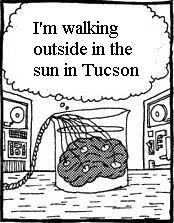
As part of a thought experiment originally proposed by Daniel Dennett, assume that your brain has been removed from your skull and placed in a vat of chemicals that nurture it. Your body has total, unimpaired ability to move about, although minus your brain. Instead, in your cranium is a transmitter that sends sights, sounds, touches, and scents, back to the brain. While your body roams freely, your brain remains in the vat, experiencing whatever the body encounters.
Where would you locate yourself? Most people would say they would believe themselves not in the vat but wherever their body goes. They would still feel that they lived somewhere behind the eyes. Only a transmitter is located there.*
So where, then, is the self, this seemingly basic element that everybody senses as present, and discusses as if it is real? What about all the words referring to it--I, you, him, or her? Apparently, because the self cannot be located, they belong to the metaphysics of grammar. (See The Metaphysics of Grammar, 17 January 2004.)
We feel that we are a central observer, but wherever we look we don't find him or her. We are the teller of our tale. We have a narrator, so we believe, and this narration shapes our lives. Where is the narrator?
If we cannot find the teller, then what about the tale? We have memories and hopes. We locate ourselves in space and time. Still, without a teller, where is the tale? (See Perception, 8 December 2003.)
In quantum physics, evidence mounts to indicate that consciousness is non-local. This would not surprise a Ramana Maharshi or a Dogen Zenzi. (For an article on non-local consciousness, see John Bell's Inequality Theorem and Alain Aspect's experiments, in Looking For Reality, 10 November 2003.)
Even non-local consciousness does not fully explain the fact that whenever we look for the self we cannot find it.
For further discussion of the elusive self, see Shakey, Beavers, and Cartesian Theater, 12 February 2004, Cartesian Anxiety, Francisco Varela and The Emergent Self, 6 January 2004 and Benjamin Libet's experiments in Looking for Self, 8 November 2003, as well as various other articles at this site.
For another brain/vat thought experiment, see Brain In A Vat, a different proposal, 20 November 2003.
* (Is this similar to the phantom limb syndrome, in which one feels a foot itching even though the leg was amputated?)
11/10/03
Looking for Reality: Billiard Balls, Einstein, and Nisargadatta

Looking for Reality: Billiard Balls, Einstein, and Nisargadatta
A billiard ball strikes another and moves it across the table. The proximity of the one effected a change in the second. Right?
Einstein said so. He, of course, took it further and asserted that the speed of light is an absolute, a constant, that determines physical effects, none of which can be transmitted faster than its own speed, 300,000 kilometers per second (186,000 miles per second). Things happen locally, not across great distances, he added. Although Einstein didn't put it in the same manner, his principle also holds that when nobody is in a forest to hear a tree fall, there is sound nonetheless.
Then along came Quantum Theory and a physicist named Werner Heisenberg who challenged Einstein's theory. Einstein's view had reality as something with falling trees making sounds, and particles giving simultaneous position and velocity--something like a car crossing a railroad track at twenty miles an hour. (This is not a good comparison, but it helps impart the idea of position and velocity.) Heisenberg found that he couldn't have it both ways. He could either "snapshot" a particle's velocity or its position, but not both, which is akin to saying that we can describe that the car travels at twenty miles an hour or that it crosses a railroad track, but not both. On the quantum level the world simply didn't behave as Einstein conceived it on the large, gravitational level.
The point here: if things happen locally, if the local implies the real, then why can't both position and velocity be described at the quantum level?
Things happen locally?, somebody might ask, then reply, Why of course they do. Reality is based on conditions right in front of us. Things, and the conditions for an event, can't happen anywhere else but where we see an occurrence. Right?
Not necessarily.
John Bell had problems with this. In 1965 he wanted to determine whether reality could be described by a theory supporting local variables. For this purpose he developed an Inequality Theorem. This didn't work as it, too, implied non-locality. Subsequent experiments by other physicists indicated that reality, if there is one, cannot be local. (This, of course, comes as no surprise to a Zen master who teaches Big Mind, or a Hindu sage who speaks of Consciousness with a capital C. That art thou, as an ancient Sanskrit saying has it.)
In 1982, Alain Aspect conducted experiments at the University of Paris-South to determine if reality is non-local. His photon detectors were forty feet apart (12 meters) in order to record events at Track X and Track Y, sufficiently distant from one another. For purposes of this explanation, here is a key element of his experiments:
What implications for the outcome? If reality is local, then measuring the photon in X would have no effect on measurement of the photon in Y. If non-local, then measurement at X can affect measurement at Y.
What did Aspect discover? That measurement at X affected measurement at Y. The findings imply that Einstein was wrong about locality and that the speed of light may be irrelevant to some events, or (horror! heresy!) something there is which travels faster than light. In any event, reality is non-local.
A humble Indian merchant, Nisargadatta, had a different view of the entire matter. This is how he put it in I Am That:
"There is no such state as seeing the real. Who is to see what? You can only be the real, which you are, anyhow. The problem is not mental. Abandon false ideas, that is all. There is no need of true ideas. There aren't any. " (359-60)
Subscribe to:
Posts (Atom)