![]()

 |
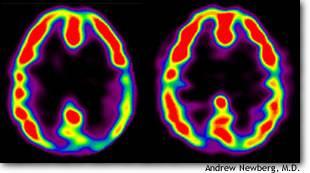
| MRI Brain Scans |
Evolutionary Psychology and Moral Dilemmas
Evidence of evolutionary psychology and brain research suggests that morality is based on what feels good rather than on what is right. That is, moral judgments tend to be emotional rather than rational. Eighteenth Century philosopher David Hume anticipated this situation when he argued that people call an act good if it makes them feel good, not because it is rationally good. Moral knowledge, he said, comes partly from an "immediate feeling and finer internal sense."
In terms of simple morality, research indicates that subjects have no problem. Magnetic Resonance Imager (MRI) brain scans show that that they have straight-forward reactions to simple moral situations. They easily choose not to kill, as an example.
Other situations are not as easily decided, particularly when at least one decision scenario conflicts with basic emotional repugnance against a deed. As an example, see
The Buck Stops Here: A Moral Dilemma and Thought Experiment, 11 February 2004, in which one moral choice involves laying hands on another human to kill him. In that regard, especially see
How Your Brain Is Hard-Wired: The Trolley Problem 25 March 2014. In addition to the choices offered in that article, consider this one: You can simply re-route the runaway trolley so to kill one person rather than many. In MRI experiments, subjects are less troubled by this option as it involves an impersonal operation of a mechanical track switching mechanism. This is similar to Version 3 in the 11 February article, wherein one need not personally lay hands on another human to kill him in order to save others.
When a child, I was told by my parents to eat all my food and to think of the starving children in China. This had little moral affect on me as I simply could not think of them. They were too many and too far away. This attitude seems hard-wired into the human brain, although from a rationally moral standpoint, there should be no conflict between the starving children and a scenario with a drowning infant. Suppose you are out for a walk in a park and see an infant fallen into the water, drowning. You must run into the water immediately but you wear brand new $150 shoes that will be ruined by a plunge into the pond. Most people do not hesitate to say that they would try to rescue the baby. Yet, in Africa thousands of children die daily because of disease or hunger. That same $150 could buy medicine and food, although somehow the thought crosses few people's mind when they eat at a restaurant or shop at a shoe store. Evolutionary psychology provides one explanation for their failure to make a connection between the two scenarios. Morality became altruism toward the tribe or family as such behavior promoted survival of the group, but was excluded from anybody outside.
Earth's problems include global warming, which most people recognize while they continue to look the other way. Populations continue to explode in have-not countries while famine and disease increase. Technology has become a machine that money serves rather than one that serves the people. Today we need a view of the world that transcends evolutionary morality, although it remains only a possibility.
People respond to the weather, a smile, food in the stomach, but switch channels on beholding a child, belly distended from hunger. Is it a matter of brain hard-wiring? Or can human reason prevail? If it should, how so? Immanuel Kant believed that reason alone leads us to moral truths. Was he right? Or was John Stuart Mill? Mill held that right and wrong is determined by the greatest good for the greatest number. Kant put right before good while Mill put good before right. Kant believed in a God Who ordered the universe while Mill did not.
*
A variant of the last episode of M*A*S*H has villagers hiding in the basement while enemy soldiers search the house above. Among the hiding villagers, a baby starts to cry, and its noise will draw the soldiers to the basement to kill everybody. Either the baby dies or everybody does. Would you kill the baby? Why? Why not?
If your brain were scanned by MRI, it would probably display areas registering emotional repugnance to the problem. People have a natural tendency to turn away from such issues. Perhaps this also helps explain why they turn away from environmental issues or those in need on far-off continents.
* (Mill: "God is a word to express, not our ideas, but the want of them." Kant: "We see things alter, come into being, and pass away; and these, or at least their state, must therefore have a cause.")
(For another moral dilemma and thought experiment, see
John Rawls and Social Justice, 7 January 2004.