AddThis

Showing posts with label Death. Show all posts

5/22/12

How to Whistle Through the Graveyard

Woody Allen said he has nothing against death. He just doesn't want to be there when it happens. He also said he didn't want to achieve immortality through his work... He wanted to achieve it through not dying.

So what is all this fear of death? Why should we fear it so much?

8/12/10

A Hiccup of Gross Irrationality?

According to Hindu advaita philosophy, or nondualism, your "I am" is a manifestation of the great "I AM," and for that reason you don't die because your apparent self is only an illusion, a manifestation, a projection on the screen of your mind. In Christian doctrine, our immortal souls are sent to either heaven or hell. (Fortunately, Pope Benedict not too long ago saved innocent babies from limbo by decreeing that it does not exist.) Descartes found he could not doubt that he was doubting, and for that reason he existed. Each of these perspectives provides a stratagem for positing some kind of eternal being against the fear of dying.

Of course we knew it would only be a matter of time before neuroscientists and neurophilosophers would take aim at such beliefs as so much nonsense. I am reminded of Tom Wolfe's famous essay about them, titled "Sorry, But Your Soul Just Died." (See the sidebar on this page.) An argument for the evolution of the brain and from evolutionary psychology provides them with their starting point. Read on.

Some researchers "are increasingly arguing that the evolution of self-consciousness has posed a different kind of problem altogether. This position holds that our ancestors suffered the unshakable illusion that their minds were immortal, and it’s this hiccup of gross irrationality that we have unmistakably inherited from them. Individual human beings, by virtue of their evolved cognitive architecture, had trouble conceptualizing their own psychological inexistence from the start." More

1/26/10

What Comes After Death?

In our planning for tomorrow,
it has the final word,
which is always beside the point.

It can't even get the things done
that are part of its trade:
dig a grave,
make a coffin,
clean up after itself.

Wislawa Szymborska, part of her "On Death, without Exaggeration"


"During my mother’s final weeks of illness, a rabbi told her that she could choose to imagine death as an exciting possibility. His intent was to comfort, and perhaps he did. As life’s end nears, religious faith is, above all, utilitarian – a passport through regret and fear to a destination that is still unknown, uncharted.

What wouldn’t we give to know it? Better yet, to know it without being compelled to visit.

In SUM: Forty Tales from the Afterlives (Pantheon Books), the neuroscientist David Eagleman does what the rabbi urged on my mother: He lets his imagination run free. In 40 pithy vignettes, he offers variations on the theme of immortality – sketches of theoretical heavens and hells that are really philosophical musings on human striving, yearning, and fallibility.

In his search for meaning, Eagleman casts a cold eye on both life and death, thrusting us into universes tinged with sadness. The presiding deities in these stories are less often omnipotent than blundering and defeated. Their plans dazzle, but veer into blind alleys. The meticulously constructed ideal keeps colliding with reality." Found here. Click here for a Mind Shadows piece, "Whistling Past The Graveyard," on William Hazlitt, who said you have no fear of what happened before you were born, so why be afraid of what happens after?

On that somber theme, here is a wise metaphor on the metaphysics of the afterlife:

A man fell off a cliff and, tumbling down, he grabbed a small rock. He looked up at the cliff rim, so far away. He looked down at the bottom, its trees tiny in the distance, its earth waiting to flatten him. In desperation, he turned his head toward the sky and shouted for all he was worth.

"HELP! IS ANYBODY UP THERE?"

A majestic voice boomed through the gorge:

"I will help you, my son, but first you must have faith in me."

"Yes, yes, I trust you!" cried the man.

"Let go of the branch," boomed the voice.

The man paused, and shouted again,

"IS ANYONE ELSE UP THERE?"
--------------------

And finally, there is this, found on a church bulletin board:

The sermon this morning: "Jesus Walks on the Water." The sermon tonight: "Searching for Jesus"

and this, a limerick:

I get up each morning and dust off my wits,
Pick up the paper and read the obits.
If my name is not in them I know I'm not dead,
So I eat a good breakfast and go back to bed.

12/10/09

Nobody Dies


Cast a cold eye
On life, on death.
Horseman, pass by!
W. B. Yeats, "Under Ben Bulben"

The law of conservation of energy states that the total amount of energy in an isolated system remains constant over time. In an isolated system, energy can be neither created nor destroyed. Just what is an isolated system. Is it bigger than a bread box? Robert Lanza, a stem cell researcher, claims that consciousness energy occurs in the universe itself as a closed system. The system is as big as the universe, or rather, the multi-verse. The universe/multiverse, he would say, is in your head. He discusses his views in his book Biocentrism. Here are some of his views.

"Although individual bodies are destined to self-destruct, the alive feeling--the 'Who am I?'--is just a 20-watt fountain of energy operating in the brain. But this energy doesn't go away at death. One of the surest axioms of science is that energy never dies; it can neither be created nor destroyed. But does this energy transcend from one world to the other?"

"Consider an experiment that was recently published in the journal Science showing that scientists could retroactively change something that had happened in the past. [Actually, this is relatively old as a generic experiment and you can read about it in Mind Shadows in John Archibald Wheeler: Time Machines & Delayed Choice.] Particles had to decide how to behave when they hit a beam splitter. Later on, the experimenter could turn a second switch on or off. It turns out that what the observer decided at that point, determined what the particle did in the past. Regardless of the choice you, the observer, make, it is you who will experience the outcomes that will result."

"In the end, even Einstein admitted, 'Now Besso' (an old friend) 'has departed from this strange world a little ahead of me. That means nothing. People like us...know that the distinction between past, present, and future is only a stubbornly persistent illusion.' Immortality doesn't mean a perpetual existence in time without end, but rather resides outside of time altogether." More

Einstein's statement is reminiscent of a previous Mind Shadows article on Julian Barbour and Time.

A comment on the article says this: "Hindu philosophy posits that the Atman (self) and the Brahman (universe) are actually manifestations of the same thing. We are at once the universe becoming singular, and the self becoming universal."

Long ago William Hazzlitt (called The First Modern) wrote a compelling argument on how to overcome the dread of death. His thoughts can be found in Mind Shadows in On The Fear of Death.

Shakespeare's Hamlet puts the matter succinctly. Death is "the undiscovered country from whose bourn no traveller returns."

4/23/09

Whistling Past The Graveyard: Overcoming The Fear of Death

There was a time when we were not: this gives us no concern—why then should it trouble us that a time will come when we shall cease to be? I have no wish to have been alive a hundred years ago, or in the reign of Queen Anne: why should I regret and lay it so much to heart that I shall not be alive a hundred years hence, in the reign of I cannot tell whom? (On The Fear of Death, by William Hazlitt (1778-1830))

Here is a lively and entertaining discussion of the subject ;-). Check out psychiatrist and novelist Irv Yalom, author of Staring at the Sun: Overcoming the Terror of Death. He is interviewed for Philosophy Talk before a live audience at The Marsh theater in San Francisco. A good listen for every thanatophobe. Even for thanatophiles, if there are any. (Of course, there is Ella Fitzgerald singing, "I'll be glad when you're dead, you rascal, you!" But that is not about one's own death.)

A post on Near-Death Experiences (NDEs) can be found here. People who have experienced an NDE lose much of their fear of death, and this loss isn't temporary. Surveyed decades later, they still feel the same. They say they have found meaning and purpose in life, are less competitive and are more compassionate.

12/13/03

Remembrance of A Death Foretold

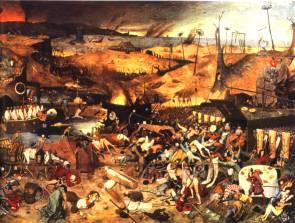
Brueghel: The Triumph of Death

Remembrance of A Death Foretold

Several years ago I received a letter from an old navy buddy. . . "By the time you read this, my last letter, I'll be gone and my ashes will be scattered in the North Atlantic Ocean.". . . . We commute to work, resolved to get the promotion, finish the project, become a better parent, not cheat on the spouse. We look at the buildings we pass, edifices of public authority, proclaiming that this is the world, that it is right and fitting to bend our lives to the edict. Sometimes we stop to ask if the lie doesn't penetrate deeper, but then we shake our heads as if caught dreaming, and we scurry to the elevator to get off at the ninth or tenth or eleventh floor.

At home, the question of the lie returns before we fall asleep. We glimpse the lie of authority; listening to the nightly news, watching the commercials, we ask Is this the Good Life? But we nod off in our easy chairs, dreaming that when we retire things will get better. Better always means when. When wealthy, healthy, happy. Better always allows us to postpone the questions, Who am I? , What is the lie? Am I just John Doe, husband, father, entrepreneur; am I only dedicated, loving, ambitious, methodical, rational, or impulsive? Is it merely the lie of authority, conformity, normality, or sanity?; of capitalism or communism or democracy or autocracy?

More