AddThis

6/29/15

Josephine Baker's Rainbow Tribe

Bookmark and Share
Taking French citizenship in 1937, Josephine Baker (1906–1975) was celebrated across Europe, especially in France, where she was known as La Baker. Treated as a "colored" woman in her native United States, she decided to adopt and raise children of various ethnic backgrounds. From all over the world she brought them to her Château des Milandes in France's Périgord region. They became her Rainbow Tribe. Of Japanese origin, Akio Bouillon was one of them. From Finland, Jarry Baker was another.

"On the surface, the children seemed to have a dream childhood. They were living in a castle, like children in a fairy tale.

6/22/15

Batman & Personality Disorder


Well, first of all, do you know anybody who wears tights with underwear on the outside? Think about it. That is a dead giveaway of something leaking inside his brain.

6/15/15

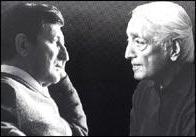
Seeing Through Self: David Bohm & Krishnamurti's Ego


Quantum physicist David Bohm (1917-1992) was a protégé of J. Robert Oppenheimer and liked by Einstein. So impressed was Einstein, that he referred to Bohm as his successor. As for Bohm, he had deep interests outside science. This led to the day when Bohm met J. Krishnamurti and began studying under him until the two men had a falling-out.

6/8/15

Lori Berenson at Middle Age

Bookmark and Share
Outraged at injustice and inhumanity, the young, naive Lori Berenson made a comment in fluent Spanish to the Peruvian press that would change her forever. She became seen as a despicable, self-important gringa. Her father said, “Forty-four seconds, and it ruined her life. It doesn’t take much.”

6/1/15

E.Allen Petersen and Hummel Hummel: A Forgotten Story of Escape and Survival

Of all the true stories lost to popular history, this one is of a remarkable and dangerous escape in the prelude to WWII.

1/19/15

Epistemology


God has a very big heart, but there is one sin he will not forgive--if a woman invites a man into her bed and he will not go. I know because a very wise old Turk told me.

Anthony Quinn as Alexis Zorba in the movie Zorba The Greek, from Nikos Kazanatzakis' novel of that name.


12/15/14

Phineas Gage: Stuff Happens

The horrible accident of Phineas Gage became a case for brain scientists to study, but for me he also represents something else. In the long history of the world it has happened as people kneel in prayer. It can occur as we gaze at a seagull, feeling ocean breeze on our cheeks, or as we enjoy orange juice and the bright feathers of a cockatoo on the patio. Above all, we want our lives to be predictable, within our control, and they seem to be for a while but one day the biopsy comes back positive for pancreatic cancer or we didn't see the car that ran a red light.

It happened to Gage one sunny Vermont day. On September 13, 1848, Phineas Gage, a handsome 25 year old railroad foreman would have his life changed forever. He would go down in history as the Gage who was no longer Gage.

12/12/14

Known Unknowns

I can thank Donald Rumsfeld for the term "known unknowns." Indeed, there are known unknowns.

That much I know, though I can never show it to you.

But think about this. Thoughts come as perceptions. They are perceived.

The perceiver cannot be found. Whatever is located when searching is only another object of thought. Perception remains, out of reach as that which is aware of the search and the thought object.

To establish a model for discussion, consider this. We cannot see black holes but we can see the gravitational lensing they cause around astronomical objects. Black holes are inferred phenomena.

9/9/14

Argentina to Alaska in A 1928 Graham-Paige

Take an adventurous young couple. Add a 1928 Graham-Paige Model 610 Touring Car. Put them in it pointed north out of Buenos Aires.

9/2/14

Wilder Penfield, Brain Maps, with V.S. Ramachandran and The Man Who Mistook His Foot For A Penis


Canadian neurosurgeon Wilder Penfield performed pioneering experiments in the 1940s and 1950s. During extensive brain surgeries, he applied electrodes to different regions of the brain and stimulated them. He then asked patients what they felt. He recorded and correlated sensations, images, even memories, as reported by the patients. By this means he mapped the brain and found, for example, that the brain area involved with lips and fingers occupies as much space as the area which handles the entire trunk of the body.