AddThis

3/27/08

Edward R. Murrow & The London Blitz


He reported live by CBS from England to America. His opening became famous. "This is London," he said in the bleak months of 1940 as wave after wave of luftwaffe bombers set fires with their incendiaries to the buildings below. Search lights lit gaggles of bombs falling through the sky as tracer bullets lit German motors and wings for RAF Spitfire pilots diving on the bombers.

The London Blitz began about four in the afternoon the 7th of September 1940, and as air raid sirens sounded, the first German bombers arrived to drop their bombs on London. Over 340 German bombers escorted by around 600 fighters dropped hundreds of incendiary bombs on the London docks. The raid lasted until 6:00 pm. A couple of hours later, the flames served as beacons for the second wave headed across the channel from France. This attack lasted until 4:30 in the morning. More than 430 people were killed, with 16,000 serious casualties. The Blitz rained death on Londoners for 57 nights in a row, sirens awakening them in the middle of the night, urging them to take shelter.

For Americans, Edward R. Murrow chronicled this horror, and he stood on London roof tops, describing the planes and bombs in the sky, the flames leaping up over London. In Ohio and Iowa, New York and California, families clustered around living room radios to hear him. He brought the war home and prepared Americans for their entry into it. He shaped public opinion and encouraged aid to Britain.

He began a sign-off that became a recent movie title. As the war from the skies raged, Londoners did not know if they would see one another in the morning. They said “So long and good luck.” Ending a live radio broadcast, Princess Elizabeth said to the Free World, “Good night and good luck to you all.” At the end of a 1940 broadcast, Murrow signed-off with Good night and good luck.” George Clooney’s movie adopted the phrase as its title, David Strathairn playing Edward R. Murrow.

In 1941, back in the USA after three years abroad, he was guest of honor at a dinner hosted by CBS at the Waldorf-Astoria, eleven hundred guests in attendance, millions more listening on the radio. Franklin Delano Roosevelt sent him a telegram. Archibald MacLeish, Librarian of Congress, gave a speech in praise of him.

  • “ You burned the city of London in our houses and we felt the flames. . . You laid the dead of London at our doors and we knew that the dead were our dead. . . were mankind's dead without rhetoric, without dramatics, without more emotion than needed be. . . you have destroyed the superstition that what is done beyond 3,000 miles of water is not really done at all.

    Murrow climbed down from the roof tops of London and into the bellies of RAF and American bombers, flying with crews over Germany. In one night bombing raid, on December 2, 1943, he flew in an Avro Lancaster with D for Dog, as its nose art. In his radio report, even today we feel his and the crew’s fear, see the German search light cones probing the sky, feel the bomber twisting and turning out of reach. You can listen his radio to report here.

    In his post war years, he became well-known for his character, integrity, and stance against ill-used power or influence. In a legendary 1954 broadcast he helped end the Red Scare and Red-baiting of Senator Joseph McCarthy. Once close friends with CBS boss William Paley, he fell out with the man, and took issue over Paley’s desire to improve profits at the expense of journalistic integrity. Paley’s successors, of course, have had their way with the media, so that today the public is entertained but rarely informed.

    Here is a live report by Edward R. Murrow from London in August 1940.

    Contrasting what London was like then (audio), to what it is today (video), this link provides a Murrow broadcast during the Blitz, and reminds us that all those 21st Century visitors don’t have a clue as to what 1940 Londoners had to endure.
  • 3/24/08


    Mind Shadows         Chris Hedges: I Don't Believe In Atheists

    “The atheists and the religious fundamentalists speak in slogans. Atheists ridicule magic, miracles, and an anthropomorphic God. They remind us that world is not 6,000 years old, that prayer does not cure cancer, and that there is no heaven or hell. But these are not thoughts. They are self-evident tautologies. These two camps never step outside their narrow intellectual boundaries. They delight in critiques that are, to any first year seminarian, shallow and stale. [Christopher] Hitchens assures us that ‘the unanswerable question of who . . . created the creator’ has never been addressed by theologians. Theologians, he says, ‘have consistently failed to overcome this conundrum.’

    “This is the declaration of an illiterate. Aquinas, along with many other theologians, addressed at length the issue of who created the creator. God, Aquinas argues, is not an entity. God is not a thing or a being. Creation is not an act of handicraft. Creation is the condition of there being something rather than nothing. Creation didn't happen long ago. Creation is a constant in human existence. It is part of life. And this is why ‘creationism’—the belief in an anthropomorphic god—is pseudoscience and pseudotheology. But stepping out of the cartoonish and childish taunting of religion to a discussion of the writings of Aquinas, Augustine, Paul Tillich, Karl Barth and Reinhold Niebuhr is beyond the capacity of these atheists. They haven't read them and they don't want to.

    “All fundamentalists reject intellectual investigations. They know the truth. They live wrapped in the comforting and self-deluding belief that they have nothing left to learn. Hitchens, for example, assures us that ‘religion spoke its last intelligible or noble or inspiring words a long time ago.’ There is no need to read theology. [Sam] Harris insists he understands the Muslim world because he has read opinion polls and passages in the Koran. These atheists, like Christian fundamentalists, maintain that one can be linguistically, culturally, historically and socially illiterate and make sweeping statements about other cultures and other traditions. This celebration of ignorance fits neatly into a world that has traded dialogue for the chanting of slogans and clichés." I Don't Believe in Atheists, by Chris Hedges, also author of American Fascists

    2/16/08


    Mind Shadows      Shift Demographics, Inc. Send Right Away For Your Personal Happiness Kit

    You are fortunate to be living in our modern world of technology and science. You need not be troubled by the deep thoughts of Greek philosophers such as Aristotle, who wrote pages about happiness that are difficult to understand and waste much of your valuable time. We can put you on the road to happiness tomorrow. Be your true, happy self!

    The ancient Greeks did not live in our computer age of lightning-fast information. They posed slow questions that took them years to answer. The questions to our modern ears even seem downright silly. For example, they asked, What makes up happiness? Or, How does it differ from pleasure? What is The Good Life? How does it contribute to happiness?

    Not only that, for the Greeks in general, and Aristotle in particular, happiness had to do with the conduct of life. Of course, they lived in the days before Prozac, so we can understand their confusion. Their view of happiness was deeply imbedded in the right way to live, which was why Aristotle titled his major work on the subject Nichomachean Ethics. Happiness had to do with right behavior in a broad sense. You might spend years trying to figure out what that means, and time is money.

    The Greeks took such questions to an extreme. For them, the question of The Good Life raised a prior one: What is the Good? For Plato, it was harmony in the parts of a man’s soul. Modern science has laid to rest such quaint notions as the soul. Aristotle had a more practical view, allying the Good with experience, not the soul, and what a man could achieve as virtue in this life, wherein the highest virtue was the contemplative life. But in our hurried age, who has time for contemplation. Here at Shift Demographics, Inc we have just the solution for you.

    We can shift your demographic data to make you happier. Here’s how it works.

    You call us and we send you a Happiness Test. The test assigns your HQ, or Happiness Quotient. It surveys information such as the following, but not limited to them:
  • Marital status
  • Income bracket
  • Residential Zip Code
  • House cost
  • Education level
  • Children/no children
    You take the survey and receive your HQ in the mail. If you want to raise your HQ, here are just a few examples. We show you how to get:
  • Married/divorced
  • Ask for a raise
  • Move to a fancier neighborhood
    Only $19.95. Hurry while survey supplies last. Simply call our toll-free number, below, to order your Happiness Kit. Satisfaction guaranteed.

    Call 1-800-JOY-FULL. Please have your Visa or Master Card ready. Offer not valid in North Dakota, Germany, or Lubbock, Texas.
  • 10/20/07

    Echolocation: Bats, Dolphins, and Ben Underwood, Who Is Blind


    Echolocation: Bats, Dolphins, and Ben Underwood, Who Is Blind

    "To society he's blind," said Ben's mother, "but that doesn't make him handicapped. He just can't see."
    One morning when he was 2, Ben woke up and told his mother, "Mom, I can't see anymore, I can't see anymore." His mother knew he had an incurable retinal cancer, and put his hands on her face. She replied, "Baby, yes, you can see. . . . You can see with your hands." She told him that he could see with his hands and his nose and his ears. She had three other children and could not afford to treat his blindness as a handicap.

    So Ben grew up without sight, but at age five learned to click with his tongue about every half second—to echolocate—to ride his bike, shoot hoops, play video games, and throw pillows at his sisters.
    Done for popular consumption, most media accounts of Ben are hyped and do not address deeper questions about the brain's ability. Neuroscientists no longer believe the occipital cortex is useless in the blind; rather, it can activate through learned echolocation. It creates images with or without eyes.

    Bats send sound signals in rapid bursts at high frequencies. Their sonar can bounce off flying mosquitoes, which the bats swoop on with open mouths. Dolphins find their meals in the same manner. It is called echolocation, using sound to identify objects and their locations. As with vision, the brain processes energy reflected off an object—only as sound rather than light. Echoes can inform Ben as to the position of objects, how big they are, their general shape, and how solid they are. Positioning determines distance and whether it is left or right, high or low, front or back. In shape, Ben tells if it is tall or short and wide or narrow. Ben may recognize a pole because it is tall and narrow. A building is tall and very broad. A pillow is soft and not dense.

    By clicking, Ben avoids curbs while riding his bicycle in his Sacramento, California neighborhood. Even though he can't see the hoop, he can sink a basketball through the basket. He plays video games by distinguishing sounds. He is writing a novel, typing it at 60 words per minute on a standard keyboard. He roller blades, plays foosball and skate boards. His eyes are artificial, so they see nothing. "I can hear that wall behind you over there. I can hear right there -- the radio, and the fan," Ben told one reporter.
    Ben is not the only blind person who has developed echolocation. Others are Daniel Kish, 40, of Long Beach, California, who leads other bind people on hikes in the wilderness or in mountain biking. "I have mental images that are very rich, very complex,” says Kish. He can describe the awesome beauty of a wilderness scene. James Holman (1786-1857) used the sound of a tapping cane to travel around the world.

    In an earlier post, I did a piece on Graham Young, a man who is blind but somehow can see. Young can sense moving objects but doesn't know how he does it. V.S. Ramachandran, a neuroscientist, has a plausible explanation for Young's ability.

    Though we have explanations for Ben's ability, not nearly enough research has been done on this phenomenon and, despite remarkable progress, the brain itself remains a largely unexplored frontier, an unknown continent. We look out into space and imagine black holes and time warps, but an entire universe also lies in the other direction.


    I am left with mystery.  Sadly, this amazing boy died of another cancer after the one that took his eyes.

    10/17/07


    Mind Shadows      Martin Seligman & Authentic Happiness Against Eternal Sunshine of The Spotless Rind

    If only you were rich, you'd be happy. Right? Or, if only you were like movie stars Brad Pitt or Cate Blanchett, you'd be happy. Why not? Money and a life of glamor or leisure would be the ticket to happiness--so many people think. This view stems from a popular conception that pleasure is the same as happiness. For that reason, a hedonic calculus is in order, one which seeks pleasure for its own sake while shunning negative feelings. This viewpoint is misguided according to Aristotle, who saw in Eudaimonia, or the Good Life, a means to happiness that is remote from the popular perspective. A contemporary psychologist has applied his own research to Aristotle's philosophy, and has come up with a guide to happiness that is designed for modern people. If life gives you lemons, make lemon peels--so goes one approach. That which is sour can be turned into meaning, which is better than pleasure. More.

    10/11/07


    Mind Shadows Misconceptions About Happiness (Maybe You'd Really Rather Have A Candy Bar)

    Hire An Expert: People Aren't Too Good At Estimating Their Own Feelings


    Are you happy? Depressed? Sometimes one, sometimes the other? Do you want to be always happy? Is happiness more important than money?

    Tim Wilson, University of Virginia, George Loewenstein of Carnegie-Mellon, and Nobel laureate in economics Daniel Kahneman of Princeton have studied emotional and behavioral prediction. They have examined decision-making processes that shape people's sense of well-being.

    You may be temporarily happy if you buy a new car, new house, new suit, new shoes. You may get a lift from a job promotion. But it won't last. None of it. Not according to their findings.

    This is news? Well, no, it's common sense. Jon Gertner has written a a book titled The Futile Pursuit of Happiness. So what did Gilbert write a book about?

    He says that your imagination of a happy state is always greater than the happiness you achieve, whatever you do. Your expectation of how you feel is always less than what you experience after you remodel your kitchen or make some money on the stock market.

    The same situation applies for unhappiness. You fear a divorce because the implications are just too awful to think about. Yet, should divorce happen, you discover that the setback doesn't last. Suppose somebody dies in the family. Yes, the death is crushing, but that, too, eventually is gotten over.

    So the question is, What about decision-making as it shapes our sense of well being? Given what we think we choose, is the choice always for happiness? In short, how do we predict our future feelings? After all, that is what decision-making is based on. Mostly we want to have good future feelings, and avoid bad ones.

    So people spend money to buy happiness. Basically, for consumer society, that is it. The economic engine would stop if people ever truly realized the old adage, Money can't buy happiness.

    Research through experiments has found that people are not very good at understanding what will improve their well being. It seems that people make bad life choices because they have faulty estimations of their future emotional state. Overall, they are poor judges of future events, good or bad, which prove less intense and more transient than they predicted.

    Of course, here the researchers couldn't delve into the epistemology and physiology of decision-making. They simply focused on experiments in observing and questioning people engaged in everyday tasks.

    But does anybody really make a decision? Read Daniel Dennett, 15 December, Daniel Wegner, 12 December, and the 8 November article about Benjamin Libet's experiments.

    Home

    9/23/07


    Mind Shadows      Nassim Nicholas Taleb & Black Swans

    Before the discovery of Australia in the 17th Century, Black Swan was a metaphor for something that did not exist. Dragons, incubi, and succubi, were all Black Swans to the Renaissance intellectual. The term became established as a kind of principle for inductive reasoning. Throughout the known world only white swans could be found. This was sufficient empirical evidence to establish that black swans only occurred as creatures of fanciful imaginations. White Swans were predictable. They could be found everywhere, and so the world of inductive reasoning could conform to the prediction.

    Then in Australia black swans were discovered. With that discovery, Francis Bacon (1561-1626) was posthumously proved right in his admonition to beware fallacies of reason, specifically, "Assuming more order than exists in chaotic nature."

    Of course, we need to believe in White Swans, else our brain frontal lobe would become a circuitry of tension, fear, and anxiety. Certain beliefs are necessary for us to go about our daily affairs and do them effectively. As William James (1842-1910) put it, we will believe; we can't escape belief. The human mind is wired so that it cannot avoid taking a position. (See his The Will To Believe.) In short, we need to believe in predictability and we will believe in it.

    Karl Popper (1902-1994) punctured the balloon of science in a certain regard when he used Black Swans to point out that scientific knowledge does not advance solely by inductive reasoning. That is, observation of data does not necessarily lead to generalizations about data so that a theory is formed. Quite simply, if a single researcher finds one black swan, then he can never make a leap to a universal conclusion. All of his research remains falsifiable, that is, disprovable, and only by this means does science advance.

    Along comes Nassim Nicholas Taleb with his book, Black Swan: The Impact of The Highly Improbable, in which he develops a theme. Taleb declares that we tend to bet that past events will repeat themselves. His interest is the stock market, and he is a "Quant," a trader sharp in math and interested in the quantitative analysis of markets, by which he has laid aside wealth sufficient to make himself financially independent. Finance, he says, is for Philistines.

    Taleb observes that in both the market and world events, real changes have resulted from the Black Swans, the rare and unpredictable. Neither the nation nor the market was ready for September 11, 2001. The world could not have foreseen the consequence of Martin Luther's 95 theses, and Johann Gutenberg's Bible. People today little understand that together, Luther and Gutenberg radically changed history, the one revolting against papal abuses while the other rendered Scripture out of Latin and into common languages. In 1905 an obscure young clerk in a Swiss patent office had world-shattering effect when he published in Annalen der Physik a nineteen page paper on Special Relativity.

    Taleb states that "History does not crawl, it jumps." He takes aim at probability based on the bell curve, with most frequent occurrences in the middle. Common associations with the curve are IQ scores. Most of the population finds itself in the middle with less frequent outliers on either end. This kind of predictability he calls "Mediocristan." Instead, he insists that our world is shaped by Black Swans, huge, sometimes violent, swings that he calls "Extremistan."

    He does not phrase it this way, but he speaks to the illusion of control. We admire the self-made man whom we regard as having made it to the top by will, ambition, determination, and, most of all, his own free choices. Instead, Taleb insists that all too often what we really admire is luck. He would put it in closely reasoned language, but here it is. Life can be a crap shoot. The dice fell sixes for one guy and for another guy equally capable they came up snake eyes. Historians use intention and design to explain a man's rise to power and influence when in fact he rolled sixes several times in a row.

    Taleb has an original mind and an original approach. I must say that I will revisit his book for it offers much to think about. He is not to be brushed aside.

    Evolution did not wire my brain's frontal lobe to prepare for Black Swans. Some events happening in the past are likely to happen again; that's all it sees. This seems fitting because of its need for equilibrium, not anxiety and fear. Whatever the neuroscientific explanation for its need, I want happiness. Happiness does not fit into the discourse of Bacon, Popper, or Taleb, but each would agree that it is the one thing to be desired, regardless of the form it takes. Yes, an asteroid may at this very moment be plunging through black, cold space on its way to wipe out humanity, but if I can't do anything about it, why sweat it? I am wired to worry when I should; otherwise, I want things that make me happy. While acknowledging the sometime folly, I'll settle for the probability of White Swans occurring more frequently than Black. As for the Black, as bumper stickers eloquently proclaim, Shit happens.

    3/14/07

    Milan Kundera and Loren Eiseley: Consciousness and The Scientific Model


    Milan Kundera and Loren Eiseley: Consciousness and The Scientific
    Model

    While I was sitting one night with a poet friend watching a great opera performed in a tent under arc lights, the poet took my arm and pointed silently. Far up, blundering out of the night, a huge Cecropia moth swept past from light to light over the posturings of the actors. “He doesn’t know,” my friend whispered excitedly. “He’s passing through an alien universe brightly lit but invisible to him. He’s in another play; he doesn’t see us. He doesn’t know. Maybe it’s happening right now to us.” Loren Eiseley, The Immense Journey


    Living in an age dominated by science, we have come more and more to believe in an objective, empirical reality and in the goal of reaching a complete understanding of that reality. Part of the thrill that came with the announcement that the human genome had been mapped or with the idea that we are close to understanding the big bang rests in our desire for completeness.

    But we’re fooling ourselves. . . . . We are like Loren Eiseley's moth, blundering from light to light, unable to discern the great play that blazes under the opera tent. The American Scholar

    The American Scholar article deals with a viewpoint familiar to this blog; I've argued here in Mind Shadows that despite Daniel Dennett's Consciousness Explained and other neuro-scientific faith, a wholly satisfactory model for consciousness will never happen.

    Eiseley's remark reminds me of Milan Kundera's The Unbearable Lightness of Being. At the end of the novel, Tomas and his wife are about to die. Their truck's brakes will fail on a mountain road. On the last
    night of their lives they dance together in a dingy Soviet-era hotel. Tomas, promiscuous, has finally surrendered to her, long suffering and faithful to him. "I have no mission," he says.

    They go to bed. The book ends on these sentences: "Up out of the lamp shade, startled by the overhead light, flew a large nocturnal butterfly that began circling the room. The strains of the piano and violin rose up weakly from below." Another parabola intersects with their decline into death, and the nocturnal butterfly does not even know it is night.

    10/1/06

    Where is Riverbend, The Baghdad Burning Blogger?


    Where is Riverbend, The Baghdad Burning Blogger?


    In 2003, when I began reading her, Riverbend was a 24 year old blogger of Baghdad Burning, launched August 17, 2003, after Bush's invasion of Iraq, which the administration humorously titled Operation Iraqi Freedom. Riverbend's identity is carefully hidden, but, according to Wikipedia at the time this was first written (2006), the weblog entries indicate that Riverbend was unmarried, from a mixed Shia and Sunni family, living with her parents and brother in Baghdad. Before the United States occupation of Iraq she was a computer programmer. She writes in an idiomatic English which reflects her Western education.

    She has posted riveting accounts of life in Baghdad. Plays were written about Baghdad Burning and she has won prizes, and this New York Times comment was written about her:


    "Riverbend is a thoughtful writer whose articulate, even poetic, prose packs an emotional punch while exhibiting a journalist's eye for detail." Jason Zineman, New York Times.

    Here are some of Riverbend's own comments:
    It's amazing how as things get worse, you begin to require less and less. We have a saying for that in Iraq, 'Ili yishoof il mawt, yirdha bil iskhooneh.' Which means, 'If you see death, you settle for a fever.' We've given up on democracy, security and even electricity. Just bring back the water."
    "The weapons [of mass destruction] never existed. It's like having a loved one sentenced to death for a crime they didn't commit--having your country burned and bombed beyond recognition, almost. Then, after two years of grieving for the lost people, and mourning the lost sovereignty, we're told we were innocent of harboring those weapons. We were never a threat to America. . . Congratulations Bush--we are a threat now."

    After her August 5, 2006 post she went quiet. At that time, knowing she lived in the most dangerous city in the world, I was querying others whether they know what happened to her. Here was all I found:
    "i think everyone is worried. i don't know. have not heard anything for well over 2 months. there is a chance she left the country, but that's just speculation. it's really horrible. i feel so badly about it and wish there was something i could do. she comes from a big family and i have the impression they all really hang together. i am sorry i cannot help you."

    At that time, I wrote, "I hope that she turns up, and if she does wonderful. I fervently hope she does. If she does not, you should know about another unwilling victim of Bush's 'liberation' of Iraq.

    She did return, briefly in 2013, with an update at that time. Here is the link to her blog. Baghdad Burning

    9/27/06

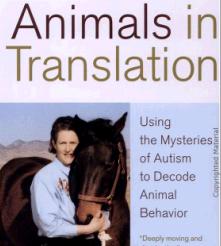
    Temple Grandin, PhD, on Her Autism


    Temple Grandin, PhD, on Her Autism

    Grandin was described by Oliver Sacks in his book, An Anthropologist on Mars. Sacks' title approximates how Grandin feels around so-called normal people. Dr. Grandin has been featured on ABC's Primetime Live, the Today Show, and Larry King Live and appeared in a BBC Horizon documentary, broadcast 8 June 2006 as "The Woman Who Thinks Like A Cow." She has been written about in periodicals, including Time, People, Forbes, and the New York Times.

    "I think in pictures," she writes. "Words are like a second language to me." More